


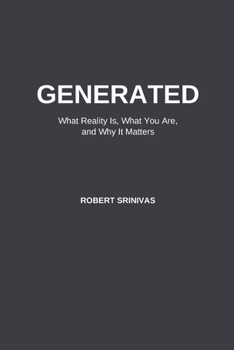
Generated
No Customer Reviews

What is reality, and how do we know it is real? Is consciousness a fundamental feature of the universe or an emergent byproduct of physical processes? And if the universe is governed by deterministic laws-or even generated by underlying computational structures-what, if anything, becomes of free will?This book examines these questions at the intersection of metaphysics, philosophy of mind, and contemporary scientific thought. Drawing on developments in physics, neuroscience, artificial intelligence, and cognitive science, it explores the possibility that reality may be structured more like an interface than an objective, observer-independent world. Perception, on this view, does not reveal reality as it is, but rather presents a model optimized for survival, coherence, and action.Through a careful analysis of consciousness, causality, and agency, the book challenges traditional assumptions about materialism, realism, and human autonomy. It considers whether deterministic or simulated frameworks necessarily undermine meaning and responsibility, or whether a more nuanced understanding of agency can survive within constraint-based systems.Written for thoughtful general readers as well as those with an interest in philosophy and science, this work does not offer simple answers or speculative excess. Instead, it invites readers to confront uncertainty honestly, to rethink the relationship between mind and world, and to consider what it means to live deliberately inside a universe that may be stranger-and more intimate-than we have been taught to believe.
Format:Paperback
Language:English
ISBN:B0GN5JDMJ8
ISBN13:9798295512421
Release Date:December 2025
Publisher:Robert Srinivas
Length:548 Pages
Weight:1.60 lbs.
Dimensions:1.2" x 6.0" x 9.0"
Related Subjects
PhilosophyCustomer Reviews
0 rating
Copyright © 2026 Thriftbooks.com
Terms of Use | Privacy Policy | Do Not Sell/Share My Personal Information | Cookie Policy | Cookie Preferences | Accessibility Statement
ThriftBooks ® and the ThriftBooks ® logo are registered trademarks of Thrift Books Global, LLC
ThriftBooks ® and the ThriftBooks ® logo are registered trademarks of Thrift Books Global, LLC
