


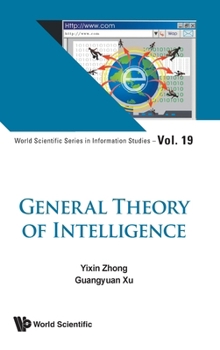
General Theory of Intelligence
No Customer Reviews

This book is distinguished by the following features:
It recognizes that AI, as a complex information system, should adhere to the scientific worldview and methodology of the information discipline-collectively termed the paradigm for information discipline (PID). Yet, because "consciousness lags behind existence," the PID has not yet taken shape. Existing AI has instead followed the paradigm for the physical discipline (PPD), resulting in profound distortion and alienation.It articulates the PID and initiates a paradigm revolution in AI: the PID governs AI's information-ecological processes, while the PPD guides its material support systems and energy supply systems.This paradigm revolution reveals a universal mechanism of intelligence generation-the Law of Information Conversion and Intelligence Creation-and thereby establishes the Mechanism-based Theory of Artificial Intelligence (MTAI).The MTAI addresses the shortcomings of existing AI, including the crisis of humanism arising from alignment; the enormous resource expenditure caused by statistical decision-making and its requirement for ergodicity; the impairment of understanding caused by formalization, manifested as hallucinations; and the loss of AI's holistic capabilities resulting from a divide-and-conquer approach.It discovers that the "universal mechanism of intelligence generation" underlies not only the generation of intelligence across diverse AI application systems but also the generation of human intelligence, thereby establishing the MTAI as a "General Theory of Intelligence."In sum, the book's key concepts include the paradigm for information discipline, the paradigm revolution in AI, the universal mechanism of intelligence generation, the mechanism-based theory of artificial intelligence, and the general theory of intelligence.
Format:Hardcover
Language:English
ISBN:9819830818
ISBN13:9789819830817
Release Date:October 2026
Publisher:World Scientific Publishing Company
Length:668 Pages
Weight:3.03 lbs.
Dimensions:1.9" x 6.0" x 9.0"
Customer Reviews
0 rating
Copyright © 2026 Thriftbooks.com
Terms of Use | Privacy Policy | Do Not Sell/Share My Personal Information | Cookie Notice | Cookie Preferences | Accessibility Statement
ThriftBooks ® and the ThriftBooks ® logo are registered trademarks of Thrift Books Global, LLC
ThriftBooks ® and the ThriftBooks ® logo are registered trademarks of Thrift Books Global, LLC
