


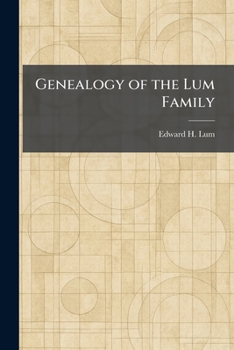
Genealogy of the Lum Family

Select Format
Select Condition 
Book Overview
"Genealogy of the Lum Family" is a comprehensive historical record compiled by Edward H. Lum, offering an in-depth exploration of the lineage and heritage of the Lum family in the United States. This meticulously researched volume traces the family's roots from their earliest known ancestors, documenting their arrival in America and their subsequent expansion across various regions. The work serves as an essential resource for descendants and historians alike, providing detailed accounts of individual family members, significant life events, and the historical contexts in which they lived.
Focusing on the preservation of family identity, the book captures the essence of the American genealogical experience during the colonial and post-colonial eras. It includes vital statistics, biographical sketches, and connections between different branches of the family tree. By cataloging names, dates, and locations, Edward H. Lum ensures that the legacy of the Lum name is preserved for future generations. This work stands as a testament to the importance of ancestral documentation and offers valuable insights into the social and migratory patterns of early American settlers. Whether for personal research or broader historical study, "Genealogy of the Lum Family" remains a significant contribution to the field of American family history.
This work has been selected by scholars as being culturally important, and is part of the knowledge base of civilization as we know it. This work was reproduced from the original artifact, and remains as true to the original work as possible. Therefore, you may see the original copyright references, library stamps (as most of these works have been housed in our most important libraries around the world), and other notations in the work.
This work is in the public domain in the United States of America, and possibly other nations. Within the United States, you may freely copy and distribute this work, as no entity (individual or corporate) has a copyright on the body of the work.
As a reproduction of a historical artifact, this work may contain missing or blurred pages, poor pictures, errant marks, etc. Scholars believe, and we concur, that this work is important enough to be preserved, reproduced, and made generally available to the public. We appreciate your support of the preservation process, and thank you for being an important part of keeping this knowledge alive and relevant.
Related Subjects
ReferenceCustomer Reviews
ThriftBooks ® and the ThriftBooks ® logo are registered trademarks of Thrift Books Global, LLC
