


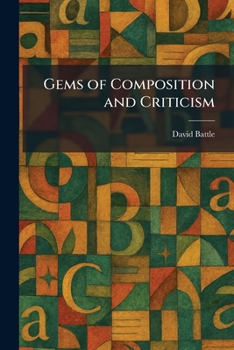
Gems of Composition and Criticism

"Gems of Composition and Criticism" is an illuminating anthology and guide compiled by David Battle, designed to showcase the pinnacle of English prose and the art of literary analysis. This work serves as a comprehensive resource for students of rhetoric, writers seeking to refine their craft, and readers who appreciate the nuances of well-constructed language. By gathering together notable passages and insightful critiques, Battle provides a roadmap for understanding what constitutes excellence in writing.
The volume explores the fundamental principles of composition and the rigorous standards of literary criticism prevalent in the early 20th century. It offers a curated selection of "gems"-passages that exemplify clarity, elegance, and persuasive power. Through these examples, the book delves into the mechanics of style, the importance of structural integrity, and the philosophical underpinnings of effective communication. Whether used as a textbook for formal instruction or as a companion for personal study, "Gems of Composition and Criticism" remains a valuable testament to the enduring importance of linguistic precision and critical thought in the literary arts.
This work has been selected by scholars as being culturally important, and is part of the knowledge base of civilization as we know it. This work was reproduced from the original artifact, and remains as true to the original work as possible. Therefore, you may see the original copyright references, library stamps (as most of these works have been housed in our most important libraries around the world), and other notations in the work.
This work is in the public domain in the United States of America, and possibly other nations. Within the United States, you may freely copy and distribute this work, as no entity (individual or corporate) has a copyright on the body of the work.
As a reproduction of a historical artifact, this work may contain missing or blurred pages, poor pictures, errant marks, etc. Scholars believe, and we concur, that this work is important enough to be preserved, reproduced, and made generally available to the public. We appreciate your support of the preservation process, and thank you for being an important part of keeping this knowledge alive and relevant.
Customer Reviews
ThriftBooks ® and the ThriftBooks ® logo are registered trademarks of Thrift Books Global, LLC
