


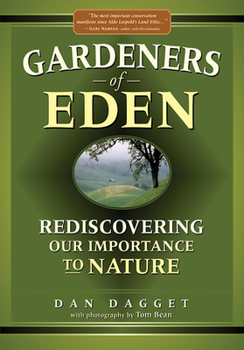
Gardeners Of Eden: Rediscovering Our Importance To Nature

Select Format
Select Condition 
Book Overview
Dagget's ideas fly in the face of our culture's ancient assumption that humans are separate from nature and of current notions that the best way for us to protect the land is to leave it alone. He... This description may be from another edition of this product.
Format:Paperback
Language:English
ISBN:096662291X
ISBN13:9780966622911
Release Date:August 2005
Publisher:University of Nevada Press
Length:180 Pages
Weight:1.29 lbs.
Dimensions:11.0" x 0.8" x 8.5"
Customer Reviews
5 ratings
This book should be used in our public schools!
Published by Thriftbooks.com User , 15 years ago
In this book Dagget examines our roll as humans on the earth. Is it best to stay out of nature and let it take it's course or should we get involved and help it flourish and benefit mankind? This book changed my outlook and I believe everyone on the planet would benefit from reading it.
Sustainable Land Conservation
Published by Thriftbooks.com User , 17 years ago
Review of Dan Dagget's Gardeners of Eden: Rediscovering Our Importance to Nature (2005) by Lisa Maria Fox In Gardeners of Eden, Dan Dagget explores a new dynamic of land conservation, which is challenging the traditional "protection-based" land conservation practices south of our borders. This book provides us with the genesis of what could be an important dialogue about land management and conservation in Alberta. Alberta sits on the edge of a new era where we are challenging existing governance models, introducing new frameworks for land-use and watershed management. Some folks are responding to these pressures by embarking upon a desperate race to find and conserve vast tracks of wild lands and prairie grasslands as parklands. Much of Alberta's native prairie landscape has been managed by generations of ranchers and grain farmers. Recent economic growth demands land, and this has challenged landowners with the conflict of selling out to developers or preserving the heritage of the agricultural community by dedicating land to "land trusts" to be managed for conservation. Land trusts are but one of the tools in the conservation tool box along with dedication of parkland by the province. In the name of land conservation - the goal is to conserve large tracts of native prairie landscapes and unique biodiversity hot-spots in various sizes and with varying degrees management. One Alberta rancher decided that if he couldn't stop the sprawl of an urban center - he would try to manage the impact on his small piece of ranchland. Tim Harvey, a local agricultural producer and landowner west of Calgary recently decided to sell 1,300 hectares of land to the province as a park in the name of conservation. The Harvey family also set aside over $6 million to support the transformation of ranchland to parkland. Not dissimilar to our neighbors to the south of the border, there are differences in opinion between land-owners and conservationists in how we expect land conservation to yield rewards, and these opinions will vary within and across the diverse landscape and roll with the tides of economic pressures. The Gardener's of Eden provides us with a perspective that demands we look outside of the box to find a common ground between conservationist and the perpetual culture of extracting our fiber, our food, and our resources from the land. Dagget offers the conservationist an opportunity to see land as a resource to be managed and challenges our notion of protection by eliminating our interaction with the land and encourages landowners to be "gardeners" and to manage the land within the symbiotic rules of the ecosystem's checks and balances. In Gardener's of Eden, Dagget maintains that "the health of a piece of land or a collection of ecosystems is not a matter of their condition. It is purely a matter of how that land is managed." I wonder if we cannot borrow some of the examples and perhaps even the philosophy of land management to help
Discovering Our Importance TO Nature
Published by Thriftbooks.com User , 18 years ago
Dagget's first book, "Beyond the Rangeland Conflict, Toward a West That Works," was nominated for a Pulitzer Prize. His latest work, "Gardeners of Eden: Rediscovering Our Importance To Nature" ($24.95 in large-size paperback from The Thatcher Charitable Trust and EcoResults!) expands on his alternative view to the "leave it alone" philosophy that has governed much thinking about the environment in the last few decades. According to a press release, EcoResults!, of which Dagget is CEO, is "a nonprofit foundation that finds funding for land managers seeking to turn their operations into a means to restore and sustain environmental values." Just what that means is the subject of "Gardeners of Eden," a lively and personal exploration of how a new kind of environmentalism is being born among those who see themselves, and their skills, as part of the ecosystem, part of nature. The huge mistake we modern humans have made, Dagget insists, is in thinking that "the only way we can really heal the land is to protect it from impacts created by humans: to 'leave it alone.' This widely held assumption is why, when we talk of healing the land, we invariably talk of protecting it, of preserving it. ... That's why articles that deal with land issues treat the word 'protecting' as having the same meaning as 'healing' or 'restoring.' It is why those articles never explain how protecting the land will heal it." The assumption that healthy land is land humans leave alone is based, he writes, on another assumption: "that all environmental problems are caused by humans. ... We don't think of butterflies or deer or wolves as creating environmental problems." But, says Dagget, there is a group of what he fondly calls "Lost Tribe gardeners" whose actions have benefited the land, have made it "outperform the Leave-It-Alone approach." To these people, such as Tony and Jerrie Tipton, who solved an "eco disaster" in the Nevada desert, the word "protection" is another name for "abandonment." A Nevada mining operation had left a 300-foot pile of crushed rock "polluted with cyanide and covered with salt." The Tiptons "dragged a length of railroad rail over the part of the pile they intended to treat, breaking up the salt crust. ... Then they scattered the seed, spread the hay and straw, and released the cattle. The cows ate most of the hay and a little of the straw, and what they didn't eat, they trampled into the rocks along with the seeds and the microbe-rich organic fertilizer they provided from their guts." Years later native plants are still growing there, in an area with less an inch of rain. Early in Dagget's career he demonstrated for Earth First! and in 1992 was named to a list of top grass-roots activists by the Sierra Club. But since then Dagget has come to realize that an environmentalism that insisted on defining healthy land as that least touched by human hands -- even if those land tracts were devoid of life -- simply made no sense. His book cites many examp
One of those rare books...
Published by Thriftbooks.com User , 19 years ago
There a few books that conjure a simultaneously bizarre reaction within a soul: like a biblical epiphany, Dagget stirs new paradigms that made me so excited that I could barely put down the book to complete my daily tasks. Yet, I could not turn the page to the next chapter because the elegant revelations of our place in nature evoked so much thought and "wow", that muddying the gift of a previous chapter with another would do it no justice. Tom Bean's photography is enlightening and beautiful; a great match for a great book. Environmentalists take heed--if you think we don't belong here, you'll find that you are more alien than those who put their soul's work into the land. This book is in my life's top ten list! Rev. D.M. North Dakota
A new conflict out of an old one
Published by Thriftbooks.com User , 20 years ago
In his new book Dan Dagget describes a new conflict over management of western resources. Instead of the tired old set-piece of preservation versus extraction, we now have a fresh, new struggle between Leave-It-Aloners--as Dagget terms those who believe that the best thing for humans to do with land is to leave it alone and let nature take its course--and the Lost Tribe, who are busy reversing land degradation through use. Conflict, writes Dagget, is one of the major economic sectors to emerge from America's public lands. And Dagget himself is definitely a player. In the 1990s, he broke ranks with the advocacy-oriented Sierra Club on the grounds that results on the land counted more than prescriptions or beliefs. He began to follow the experiments of people such as Tony and Jerrie Tipton in Nevada, who were restoring grasslands on sterile, salt-encrusted mine tailings with cattle and hay where conventional prescriptions of technology and rest from grazing had failed utterly. Using cattle to restore land, Dagget found, collided with what people "knew": that cattle could not restore land, they invariably degraded it. Therefore the grassland atop the mine tailings was invisible or irrelevant. It was, he says, like showing pictures of dog tricks to a cat fanatic. The book is a wide-ranging and rapid survey of the remarkable achievements of some the Lost Tribers, which will be engaging and hopeful news to most. The theme running through is that human management has been crucial factor in creating many of the environments that we mostly now regard as natural. By ignoring or denying our participation in the landscape, we have become aliens--but in following the examples of the Lost Tribe, there are substantial opportunities to change our attitudes and behaviors, and become more native to our landscapes. These are powerful and deep issues. Dagget's Lost Tribers are practicing a kind of interdependence that offers tremendous opportunities to regenerate degraded lands and communities--opportunities that didn't exist in the old set-piece between extraction and preservation. An understanding of basic ecosystem processes underlies much of what the Lost Tribers have accomplished, and many of Dagget's readers might benefit from a basic description of the water cycle, for example, or how the biological carbon cycle operates differently in moist environments than in seasonally arid ones. But his book, outlining as it does this new conflict emerging from the old, stale one, will be a powerful creative force for change.
Copyright © 2025 Thriftbooks.com
Terms of Use | Privacy Policy | Do Not Sell/Share My Personal Information | Cookie Policy | Cookie Preferences | Accessibility Statement
ThriftBooks ® and the ThriftBooks ® logo are registered trademarks of Thrift Books Global, LLC
ThriftBooks ® and the ThriftBooks ® logo are registered trademarks of Thrift Books Global, LLC
