
Skip to content
Scan a barcode
Scan
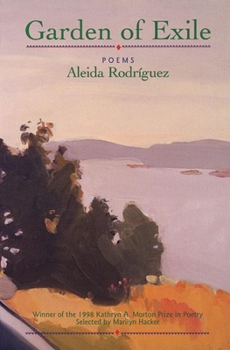
Paperback Garden of Exile: Poems Book

ISBN: 1889330337

ISBN13: 9781889330334

Garden of Exile: Poems

Select Format

Select Condition ThriftBooks Help Icon

Recommended

Format: Paperback

Condition: Very Good

$14.29
Almost Gone, Only 1 Left!
Save to List

Book Overview

Aleida Rodr guez's first full-length collection of poems, Garden of Exile, was selected by Marilyn Hacker as the 1998 winner of the Kathryn A. Morton Prize in Poetry.

Garden of Exile reveals a life enriched by layers of language and culture. Rodr'guez was born in Cuba and emigrated to the Midwest at age nine via Operation Peter Pan. These poems are psalms that celebrate the pleasures of experience made palpable through language.

Rodr guez counts her bilingual lexicon as a double blessing: "Earth's language is a continuous current, / translating the voices of my early trees along the ground./ I can't afford not to listen." In her liminal world, the lyricism of Spanish and English mingle their most gorgeous incarnations: sinsontes, ciruelas, mamoncillos, meringue clouds, and the cluck of coconuts "deliver a lost dictionary of delight."

Rodr guez is a remarkably deft poet: not only is she fluent in two tongues, she articulates the delicate nuances of daily life. Whether speaking of water, flora, or women in love, she refuses to produce the poof of easy lyric like a rabbit from a hat. Though they nod to heady pleasures, these poems keep their wits. Rodr guez remains self-possessed, intelligent, and interesting, even in her most impassioned moments. She reveals perception as the self's real alchemy and, by so doing, makes the world appear right before our very eyes.

Garden of Exile is the fifteenth poetry title to be published by Sarabande Books, a nonprofit literary press headquartered in Louisville, Kentucky. Since the 1996 debut of the press, Sarabande Books titles have received positive review attention from nationally distinguished media including The New York Times Book Review, Publishers Weekly, Kirkus Reviews, American Book Review, Small Press, The Nation, and Library Journal.

Aleida Rodr guez was born on a kitchen table in Havana, Cuba. Her poetry and prose have been published in many literary magazines, textbooks, and anthologies nationwide, including Ploughshares, Prairie Schooner, The Kenyon Review, ZYZZYVA, Southern Poetry Review, and The Progressive, as well as In Short: A Collection of Brief Creative Nonfiction (W.W. Norton, 1996), T

Customer Reviews

4 ratings

Bodies of Absence

In the poem "Exile", Rodriguez writes "After a while you begin to feel intimate with the missing part. You begin to feel it's natural not to feel pleased or satisfied. You look for houses in dead ends to live in." It is from this restlessness, this intimacy with the missing part that Rodriguez writes. She gives voice to the self that is warped through exile, that falls prey at times to fatalism, and at other times to nostalgia, while remaining self-conscious enough to avoid these pratfalls herself. If culture is the mediation of experience, then the exiled self must learn to negotiate a double (and sometimes conflicting) mediation of her experience. And if we accept the driving force of poetry to be an urge toward mystical union, then the exiled poet has a compounded sense of loss and longing to work from. Thus it is not surprising that the poet uses an epigraph from essayist Scott Russell Sanders that states "Paradise is not a place but a condition, a simple being-alive, a drinking straight from the spring." Exile is also a condition, and it is the distance from exile to paradise, the distance of the drinker from the spring, that motivates the reach of these poems. Neither space nor time are fixed, so it is natural for the poet to mourn "what memory will do to the events of this morning" (Felling the Tree) and find refuge in "That moment as permanent as a constellation" (Still Life, June 16, 1987, Oil on Board). The same poem also serves to illustrate Rodriguez' lush language, striking images and dramatic flair when she turns from describing a calm day by the beach: Then a storm rushes in with a dark crackle, a candle extinguished with wet fingertips. She notes the specific shade of navy blue the sky turns, a blotter soaking up spilled ink. Figures rise from the water and run toward the house. The air is charged, a half-moon of stillness trapped under a cup. Rodriguez' subjects (and the book's five sections) range from poetics to erotics to familial location while demonstrating control of complex forms (the sestina, the sonnet), in its successul attempt at "compressing invisible molecules together into and absence you recognize" (The Invisible Body).

exiled into eden

Perhaps unfairly, I immediately thought of Nabokov when reading Garden of Exile for several reasons. Here we find synesthesia, visual precision, and poems of Cuba, the near-mythical land she can never return to (even while seeking refuge in it), like Nabokov's Russia: half-remembered, half-invented, still and forever lost. "'Atlantis,' say, or 'Pompeii.'" But there's a purity to that loss and exile. Now Rodriguez can write from the near-edenic space of pining and lament. At the end of "Felling the Tree," the speaker's father and a man named Kique have, as you might've guessed, just felled a tree, releasing a whitefly infestation "like arrested snow flurries, or like the snow on a TV screen after the last show. Or what memory will do to the events of this morning, once these two have packed up the tools and walked, ... down the long driveway into the flickering distance" The static. The TV. What an effective figure for the artist's memory that seeks to retrieve and speak the dubious truth. In Garden of Exile, especially in the Cuentos de Cuba poems, (as in Nabokov's so-called autobio: Speak, Memory) the reader finds more of these moments, what critic Roland Barthes might call "the punctum": the photographic detail that wounds; except here, poetry allows for both the motion picture and necessary pensiveness. In the first of the Little Cuba Stories, see the bad teeth in a Cuban girl-child's 'glamor shot' and the jeep ride to the photographer's. Rodriguez's concern with the visual is painterly. Ok, enough pseudo-academic preening. Here is one of my favorite lines: "A black beetle / advances like ancient machinery" Come on. You've got to respect that. Even if critics find Garden of Exile to be unoriginal, an opinion I disagree with, the book is beautiful and works best when it engages the function, power, and limitations of overwhelming memories seeking form through fictions. Now I'm just being vague and banal. You should see for yourself. "under my skin, the rice fields of my hometown were flooding the place of language. Though my mother pulled me toward her with one arm, she scooped up only watery absence; my body had long drifted downriver...."

Morning in the garden

Aleida Rodriguez's "Garden of Exile" is an exposition of craft, from rigorously end-rhymed forms such as sestinas and sonnets to ambling meditations on identity, culture, friendship, womanhood, painting, and sex. Her voice is so settled and sure that this collection doesn't come across as a first book, or perhaps does so only in the relatively uncomplicated style of composition. Many of the poems are narrative - the "Cuentos de Cuba" section most notably, and most autobiographical - yet relaxed, the poetry resting more in verbal music than image or lyric transposition. It lends a very inviting quality to the whole enterprise, as though in reading one were simply sitting down to morning coffee in Rodriguez's garden and listening to her recount her days. Although the book is organized into clearly-constellated reader-friendly sections, there are more than a few challenging surprises, such as "The Rosario Beach House", which freely melds English and Spanish without recourse to the conventional italicization of foreign phrases. Non-Spanish-speakers might find this mystifying, but the effect for the bilingual is more one of aural magic, a liberating weave of the rhythms and sounds of both languages. Anyone who has experienced cultural displacement will find Rodriguez's ambivalence, her questioning and neverending sense of nostalgia and loss, immediately familiar. While there are parts of the book that don't hold up as well - her poems on painting pale next to her more passionate looks at sex and longing - on the whole it is an admirable debut.

Beautiful, shimmering, poetry

Rodriguez is the real deal. A poet who refuses to trade on anything but the beauty and the muscle of language. This is a powerful collection created out of a lived life. Each of these poems belongs between hardcovers. No fatty tissue here. It aches, it breathes, it sings. Great collection from a great poet.
Copyright © 2026 Thriftbooks.com Terms of Use | Privacy Policy | Do Not Sell/Share My Personal Information | Cookie Policy | Cookie Preferences | Accessibility Statement
ThriftBooks® and the ThriftBooks® logo are registered trademarks of Thrift Books Global, LLC

GoDaddy Verified and Secured