


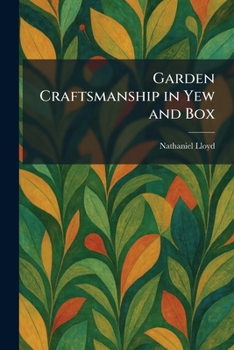
Garden Craftsmanship in Yew and Box

Select Format
Select Condition 
Book Overview
"Garden Craftsmanship in Yew and Box" is a comprehensive exploration of the specialized art of topiary and the structural use of evergreen plants in landscape architecture. Written by Nathaniel Lloyd, a prominent figure in architectural and horticultural history, this work provides a detailed look at the techniques required to cultivate and shape yew and boxwood into living ornaments. The text covers a wide array of topics, from the initial planting and training of hedges to the intricate maintenance of complex topiary forms, such as arches, buttresses, and geometric figures.
Lloyd emphasizes the marriage of craftsmanship and patience, illustrating how these slow-growing evergreens can be transformed into the backbone of a formal garden. By focusing on the practical aspects of clipping and the aesthetic considerations of garden layout, the book offers timeless guidance on creating structural depth and visual interest in outdoor spaces. "Garden Craftsmanship in Yew and Box" serves as both a technical manual and an artistic manifesto for the traditional English garden style, celebrating the enduring legacy of sculpted greenery and its role in defining the character of the landscape.
This work has been selected by scholars as being culturally important, and is part of the knowledge base of civilization as we know it. This work was reproduced from the original artifact, and remains as true to the original work as possible. Therefore, you may see the original copyright references, library stamps (as most of these works have been housed in our most important libraries around the world), and other notations in the work.
This work is in the public domain in the United States of America, and possibly other nations. Within the United States, you may freely copy and distribute this work, as no entity (individual or corporate) has a copyright on the body of the work.
As a reproduction of a historical artifact, this work may contain missing or blurred pages, poor pictures, errant marks, etc. Scholars believe, and we concur, that this work is important enough to be preserved, reproduced, and made generally available to the public. We appreciate your support of the preservation process, and thank you for being an important part of keeping this knowledge alive and relevant.
Customer Reviews
ThriftBooks ® and the ThriftBooks ® logo are registered trademarks of Thrift Books Global, LLC
