


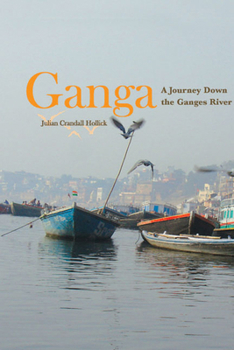
Ganga: A Journey Down the Ganges River

The Ganges has always been more than just an ordinary river. For millions of Indians, she is also a goddess. According to popular belief, bathing in "Mother Ganga" dissolves all sins, drinking her... This description may be from another edition of this product.
Format:Hardcover
Language:English
ISBN:1597263869
ISBN13:9781597263863
Release Date:October 2007
Publisher:Island Press
Length:279 Pages
Weight:1.20 lbs.
Dimensions:0.9" x 6.4" x 9.4"
Related Subjects
Asia Bangladesh Earth Sciences General Hinduism India Nature Religion Religion & Spirituality Rivers Travel Travel WritingCustomer Reviews
4 ratings
Un livre émouvant
Published by Thriftbooks.com User , 18 years ago
Je tiens à vous faire savoir ce que j'ai ressenti en lisant GANGA. Quand j'ai lu les dernières pages, des larmes d'émotion ont mouillé les pages. Ma femme et mes enfants me regardaient et m'ont demandé: mais qu'est-ce qui t'arrive ? Je ne le savais pas bien et j'ai essayé de leur expliquer. Il s'agit d'un récit sur une rivière avec son histoire, sa mythologie et ses problèmes; c'est un rapport scientifique qui se lit comme un roman policier; c'est une introduction à l'Hindouisme qui m'incite à apprendre plus sur ce sujet ; c'est la vie de tous les jours d'un groupe de personnes, qui ont choisi de travailler ensemble, avec ses drôlerie et ses réalités; c'est la vie, les croyances, les comportements, les destins de tout un peuple qui vit le long de cette rivière et de tous les autres qui se sentent concernés par elle. Et tout cela tisse un ensemble cohérent, d'émouvant, de désespérant mais non dénué d'espoir. Je viens de recommencer la lecture; j'ai peur d'avoir manqué des choses, surtout au début du livre. J'aimerais remercier l'auteur d'avoir écrit ce livre. Merci aussi à Martine, sa femme et compagne de l'avoir soutenue. Paul Meierhans, Vaison-la-Romaine
Fireside Reading for the Winter
Published by Thriftbooks.com User , 18 years ago
I recommend adding Ganga: A Journey Down the Ganga River to your stack of books for winter fireside reading. This book will take you to distant places without the hassles of modern travel. More than philosophical ruminations or an eco-travelogue this book is the engaging account of a dream realized. Tantilized by childhood stories of this great river, Crandall-Hollick goes to meet the river in person. He approaches the complex issues of the Ganga with respect and clarity. Traveling from the headwaters to the delta of the Ganga, he explores the relationship of the people who live on the banks of the river with the goddess who has abundantly blessed their lives with meaning. Reading this book I came to better understand that the people of India are not indifferent to the impact of people, pollution, and politics on the health of the river, but rather that they faithfully expect a divine solution to the complex issues that are beyond human capacity to solve. I found the chapter on bacteriophages particularly interesting, especially with the current headlines about MRSA. Perhaps there is more to the story of Naaman being healed by washing seven times in the Jordan...Scientific study and religion may have much to contribute to each other's understanding of creation. Crandall-Hollick has a deft touch with language. His descriptions of the river and the people are poetic in their accuracy. What he has seen and described is not limited by his expectations. Willing to learn and explore new ideas raised by his journey at the end of the book Crandall-Hollick raises some excellent questions on the role of economics in resolving the issues of continuing interaction of people and the river. From river bandits to temple priests many people depend on the river for life. This book has an excellent index. I recommend this book for winter reading not only to arm-chair eco-travelers, but also to the jaded cynical rationalist who is convinced that religion and science cannot work together to care for our planet.
Touching a Chord
Published by Thriftbooks.com User , 18 years ago
Touching a chord am a reader from Bangalore, India and have just finished reading GANGA by Julian Crandall Hollick, published by Random House. It made absorbing reading and I would recommend it highly to anyone who is interested in India, its peopleand their beliefs, and who has more than a touristic interest in this country. Hollick has touched a chord in the minds of all those who wonder about the strong faith that the people in this country hold about this amazing river. The first impression one gets on reading the "Ganga" is the author's sincerity. For us in India the feeling for Gangamata is part of our lives and our heritage.The divinity we ascribe to her only underlines the importance of the river in the history and geography, ancient myth and modern economic prosperity of millions of people.. To know that someone not from this country understands this in the same way is heartwarming. What is unique and most enjoyable reading is, the account of his interaction with the ordinary people he encountered on his travels down the river from source to the sea, the simple people with their down to earth philosophies and wisdom, their hospitality, and their abiding faith in Mother Ganga. Hollick is also more pragmatic about the river,pointing out dangers to which our faith in the Goddess Ganga blinds us,-- such as the many dams, barrages which change her natural flow and the waste and muck we pollute her with. We seem to accept all this over-use of the water, and the man-made pollution as something the Goddess will take care of. There is the widespread belief that Ganga purifies anything that goes into her; the author does suggest a scientific reason for this. Among the several stories about The Coming down to Earth of Ganga is one which says she was very reluctant to do so saying that she didn't want to pollute herself with the sins of humanity. Finally she was forced to obey Lord Shiva's command. I share the author's concern that our endless demands on her may result one day, in her withdrawing herself and her blessings from us...and return to her home at the feet of Lord Vishnu!! Kanaka Kini Bangalore email<kmkayindia@gmail.com
Poisoned Purity: Chasing Ganga's Silent Spring
Published by Thriftbooks.com User , 18 years ago
Julian Crandall Hollick, a journalist whose radio documentaries on sounds of India have gently woken me up on many days, has written a fabulous, conversational book that comprises a river's ecology, mythology, and, to a lesser extent, her economy. Ganga is the name of Hollick's book--simply Ganga and not the less euphonious, anglicized Ganges (note: this review is based on the Indian edition of Ganga; the American Island Press edition carries the subtitle "A Journey Down the Ganges River"). This is the river that invited Hollick to traverse her length, and she is the goddess who informs his story telling. Just as Ganga meanders through North India, Hollick weaves between the physical and the metaphysical to explore the conundrum of duality: Is Ganga a river, a goddess, or both? The answers come from Ganga's fantastical mythological beginnings and its very real and constrained present. Rather than simply repeating the origin myth of how Mother Ganga's torrential heavenly descent to earth was contained by Lord Shiva's matted hair, Hollick tells the longer, more nuanced "once upon a time" tale about imperial King Sagar. This story bookends the author's own story which begins in the Himalayas and ends at Sagar Island in Bengal. It is helpful to explore the Sagar story before proceeding with Hollick's. In the myth, Sagar performs a horse sacrifice in order to extend his kingdom. The horse wanders into a forest where Kapil rishi is meditating. Sagar's sixty thousand sons--all from one wife--give chase, but disturbed the rishi in the process; all sixty thousand are reduced to ashes. Months pass and Sagar's lone son from a second wife enters the same forest, but, unlike his brothers, Anshuman wisely waits for Kapil rishi to complete his meditation. Pointing to the ashes, the rishi tells Anshuman about his brothers' folly and suggests that only Mother Ganga can wash away their ashes and send their souls to heaven. Three generations of Sagar's sons and grandsons fail to induce Ganga to come down from heaven. Finally, his great-grandson, Bhagirath is able to please Ganga by standing on one leg for a thousand years, and the goddess consents to come to earth through the Himalayas, but only if Shiva will agree to keep her powerful waters in check by letting them run through his braided hair. Before reaching the end of his cross-country journey from the Himalayan mouth of Ganga to Sagar Island south of Kolkata, Hollick regales the reader with many more stories based in Hindu mythology and the folk culture of villages. The ride on and along the river recalls Alex Frater's Chasing the Monsoon. Both books share a palpable, liquid passion for the chase and a storyteller's love for the elusive, watery object of the chase. But along the way, a second story about ecological degradation emerges: Ganga's flow is being strangled by India's insatiable thirst for hydro-electricity and agro-irrigation. Compounding the problem of concrete dams and massive waste are indust
Copyright © 2026 Thriftbooks.com
Terms of Use | Privacy Policy | Do Not Sell/Share My Personal Information | Cookie Notice | Cookie Preferences | Accessibility Statement
ThriftBooks ® and the ThriftBooks ® logo are registered trademarks of Thrift Books Global, LLC
ThriftBooks ® and the ThriftBooks ® logo are registered trademarks of Thrift Books Global, LLC
