


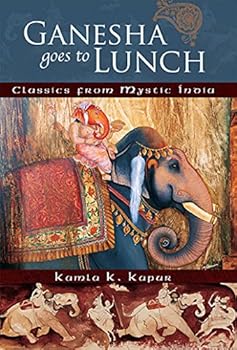
Ganesha Goes to Lunch: Classics From Mystic India (Mandala Classics)


Select Format
Select Condition 
Book Overview
King Kubera was the greediest man in the world. Hated and feared by many, he schemed to win the love of the beautiful goddess Parvati . . . but learned an important lesson when he invited her... This description may be from another edition of this product.
Format:Paperback
Language:English
ISBN:1601091028
ISBN13:9781601091024
Release Date:April 2007
Publisher:Mandala Publishing
Length:160 Pages
Weight:0.61 lbs.
Dimensions:8.5" x 0.5" x 5.5"
Customer Reviews
5 ratings
Beautiful & Inspirational
Published by Thriftbooks.com User , 16 years ago
A friend recommended this book as an introduction to Hinduism and I absolutely love it! Each chapter is a different story, and it's very informative about the Hindu Gods. There are so many morals and the author has a beautiful style of writing. Definitely recommend!
In the Company of Gods and Goddesses
Published by Thriftbooks.com User , 16 years ago
I love reading this book. I'm reading it for the second time now and I'm loving it just as much as the first time. When I close the book at night after reading a story or two, I go to sleep with a smile on my face and a happy feeling in my heart. I really, really love this book! Thanks!
Deep, delightful myths retold in simple, contemporary language!
Published by Thriftbooks.com User , 18 years ago
Ganesha Goes to Lunch by Kamla K. Kapur is a collection of twenty four stories drawn from the oral tradition of mythical tales in India. The stories are retold in contemporary language, and maintain the essential structure and characteristics of the folklores. Kamla's choice of stories ranges from tales about why Ganesha has elephant's trunk, to the marriage of Shiv-Parvati to the creation of Brahma and universe. The story of the friendship of Sudama and Krishna is retold as is the tale of Vishwamitra-Vashisht rivalry. The Bharatiya (Indian) tradition thrives on stories passed on from generation to generation. Each generation adds its own experience to knowledge and reinterprets the understanding passed to them. The Hindu myths by their very nature don't have absolutes. They represent Gods or men trapped in their vices, roused or limited by their virtues, acting in response to the demands that existence as humans on earth demands from us. The attempt is to create examples as prototypes to deal with contradictions and complexities that daily strife, be it in war, peace, family matters, need, greed, valor, and amorous desires lead us to. This had lead to several epics about avataars or incarnations, and as humans Gods lead exemplary lives, faulting at times, and suffering for them. In Kamla's collection, the gems from the boundless sea of folklore are picked, polished and repackaged to lure Western audiences as well as those Indian readers who have learned most from English education and English Literature. The book has a number of pictures and illustrations, which allow a non-Indian reader to visualize the God or character in question. We Indians grow up with these tales, and somehow we imbibe their lessons into our being without realizing when or how. The modern age has brought a slew of stories and media into our household, and in these times, it is easy to be overwhelmed by the shallow characterizations and sensationalist serials. The demands of materialistic modern life, makes it even more important for us to connect to the spiritual wisdom of centuries, the philosophy both rich and humbling is present in highly entertaining form in these stories. Kamla Kapur's effort is commendable in both the spirit and the style of execution. While most of these stories can be read out to children, a few characterizations are little more sensual than I would have hoped for. The discussion about Shiva and Shakti, the male and female powers, is done quite boldly, whereas my encounters with these stories as a child were in an understatement, and in euphemisms. Perhaps the retelling must respond to the contemporary world, where the Victorian writing, the euphemisms are considered trite and cliched. The tale from Ramayana, incorrectly mentions that Hanuman brought Sanjivini (or the hill with that herb on it) for reviving Ram (I am certain that it was needed for Laxman). Aside from these quips, most of the stories are brief and well written, and will form a go
Lively, Literate and Illuminating!
Published by Thriftbooks.com User , 18 years ago
Ganesha Goes to Lunch is a grand mix-up of Gods and mortals... all doing the best they can considering the limitations (and non-limitations) of their realities. The treat is that we are afforded a front row seat and, while enjoying ourselves all the while, suddenly discover that teachings of profound wisdom have somehow been assimilated. A wonderful and imaginative journey with the power to inform, inspire and - ultimately transform the reader. Thank you, Kamla Kapur for the (wild elephant) ride!
Ms. Kapur's marvelous collection of tales
Published by Thriftbooks.com User , 18 years ago
Ms. Kapur has done a fantastic job collecting and re-telling these tales from classic India. Her writing is beautiful and engaging and magnificently profound. I recently got this book and read a tale or two each day on my commute to and from work, and while I thoroughly enjoy Ms. Kapur's writing I really enjoy the reflection afterwards on the meanings of the tales and what they mean to my life within this universe. As with all of the very best writing, it engages the soul long after reading it.
Copyright © 2026 Thriftbooks.com Terms of Use
| Privacy Policy | Do Not
Sell/Share My Personal Information | Cookie Policy | Cookie Preferences | Accessibility Statement
ThriftBooks® and the ThriftBooks® logo are registered trademarks of Thrift Books Global, LLC
ThriftBooks® and the ThriftBooks® logo are registered trademarks of Thrift Books Global, LLC
