


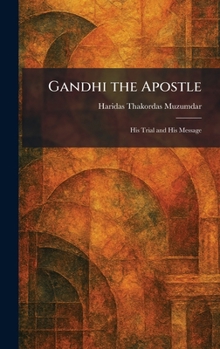
Gandhi the Apostle: His Trial and His Message

Select Format
Select Condition 
Book Overview
Beyond the courtroom, the book delves into the spiritual and ethical foundations of Gandhi's message, positioning him not just as a political leader, but as an apostle of universal peace and human dignity. It examines the socio-political climate of India and the transformative power of non-cooperation in the face of empire. This volume serves as an essential primary source for readers interested in the roots of Indian nationalism, the history of non-violent protest, and the enduring legacy of one of the twentieth century's most influential figures. Through its analysis of Gandhi's words and actions, the work illuminates the intersection of faith and activism in the quest for self-rule.
This work has been selected by scholars as being culturally important, and is part of the knowledge base of civilization as we know it. This work was reproduced from the original artifact, and remains as true to the original work as possible. Therefore, you may see the original copyright references, library stamps (as most of these works have been housed in our most important libraries around the world), and other notations in the work.
This work is in the public domain in the United States of America, and possibly other nations. Within the United States, you may freely copy and distribute this work, as no entity (individual or corporate) has a copyright on the body of the work.
As a reproduction of a historical artifact, this work may contain missing or blurred pages, poor pictures, errant marks, etc. Scholars believe, and we concur, that this work is important enough to be preserved, reproduced, and made generally available to the public. We appreciate your support of the preservation process, and thank you for being an important part of keeping this knowledge alive and relevant.
Customer Reviews
ThriftBooks ® and the ThriftBooks ® logo are registered trademarks of Thrift Books Global, LLC
