


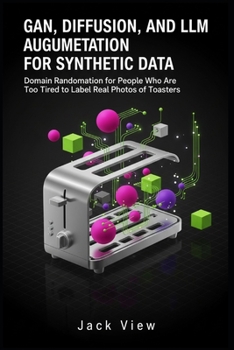
GAN, Diffusion, and LLM Augmentation for Synthetic Data: Domain Randomization for People Who Are Too Tired to Label Real Photos of Toasters

GAN, Diffusion, and LLM Augmentation for Synthetic Data
Domain Randomization for People Who Are Too Tired to Label Real Photos of Toasters
Collecting and labeling real-world data is often the most expensive and exhausting part of building machine learning systems. Thousands of images must be captured, labeled, verified, and organized-sometimes just so a model can reliably recognize something as simple as a toaster from slightly different angles.
GAN, Diffusion, and LLM Augmentation for Synthetic Data is a practical guide to generating high-quality artificial datasets using modern generative AI techniques. Instead of spending months labeling images, engineers can create vast synthetic datasets that simulate real-world variation through controlled randomness and generative modeling.
The book explores how technologies like Generative Adversarial Networks and Diffusion Models can produce realistic training images, while large language models help automate metadata creation, labeling, and scenario generation. Together, these tools enable scalable pipelines for synthetic data production.
Readers will learn how to design domain randomization strategies, generate diverse visual environments, simulate lighting and object variations, and integrate synthetic data into training workflows without degrading model performance.
With practical workflows, engineering trade-offs, and deployment considerations, the guide shows how to build datasets that are cheaper, faster, and often more diverse than traditional data collection.
Because sometimes the smartest way to train a model
is to let another model create the training data first.
Customer Reviews
ThriftBooks ® and the ThriftBooks ® logo are registered trademarks of Thrift Books Global, LLC
