
Skip to content
Scan a barcode
Scan
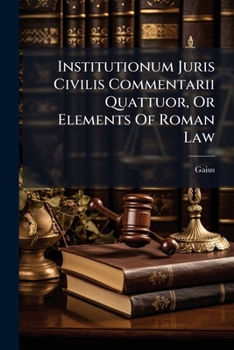
Paperback Institutionum Juris Civilis Commentarii Quattuor, Or Elements Of Roman Law Book

ISBN: 1248075773

ISBN13: 9781248075777

Institutionum Juris Civilis Commentarii Quattuor, Or Elements Of Roman Law

Select Format

Select Condition ThriftBooks Help Icon

Recommended

Format: Paperback

Condition: New

$32.95
50 Available
Ships within 2-3 days

Book Overview

Institutionum Juris Civilis Commentarii Quattuor, Or Elements Of Roman Law is a foundational text for the study of Roman law. Written by Gaius, a preeminent Roman jurist, this work systematically presents the principles of Roman civil law, providing a comprehensive overview of its key concepts and institutions. This edition offers students and scholars an accessible entry point to understanding the structure and substance of Roman legal thought. The book covers a range of topics including persons, things, actions, and delicts, making it an essential resource for anyone interested in legal history and jurisprudence.

This work has been selected by scholars as being culturally important, and is part of the knowledge base of civilization as we know it. This work was reproduced from the original artifact, and remains as true to the original work as possible. Therefore, you will see the original copyright references, library stamps (as most of these works have been housed in our most important libraries around the world), and other notations in the work.

This work is in the public domain in the United States of America, and possibly other nations. Within the United States, you may freely copy and distribute this work, as no entity (individual or corporate) has a copyright on the body of the work.

As a reproduction of a historical artifact, this work may contain missing or blurred pages, poor pictures, errant marks, etc. Scholars believe, and we concur, that this work is important enough to be preserved, reproduced, and made generally available to the public. We appreciate your support of the preservation process, and thank you for being an important part of keeping this knowledge alive and relevant.

Customer Reviews

1 rating

The One and Only Law Book from the Early Empire

Not being a lawyer, but merely a sometime student of early Roman law, I may not be the most qualified critic to review this book. But it is a remarkable enough book that I couldn't let it go without a positive comment. Composed sometime in the Mid 2nd Century AD, the Institutes is one of the most important books in Roman literature. Its unpopularity and scarcity today is no indication of its worth to the specialist and general reader alike. I won't go so far as to say it is a "delight" to read; It is still, as it was first intended to be, an introductory textbook for students of Roman Law...well, perhaps no longer such a good FIRST introduction (go to Alan Watson's "Roman Law and Comparative Law" or his "Spirit of Roman Law" for that). So what is its worth? Historically, it is the most complete of all the juristic texts written before the Theodosian Code and Justinian's Corpus. Of all the jurists represented by short citations in Justinian's Digest, only Gaius can be filled out with longer manuscripts. The result is a rich and lengthy text, which in this edition fills a sizable but portable volume (this cannot be said for Justinian's Digest). The content, caveat emptor, will seem dry to many people who approach it wihtout a good reason. As with an oracle, one should have their questions ready before they approach. A very thorough "Outline of Contents" in place of an index helps quickly orient the reader towards the answers they seek. A student of Roman law, as well as the student of American Law for that matter, will find the seeds of his or her study already firmly rooted and blooming here. The more general reader will discover an abundance of cultural facts and dilectable quanta of information. Since a culture is perhaps better reflected in its laws than in any other single institution, the careful reader can derive from the Institutes much about Romans that is hidden in Roman literature and art. For instance, slaves, who are often silent and ignored elsewehere are here represented by dozens of legal precedents. The rights and lifestyles of children, generally found only in untrustworthy (aggrandizing) biography, myth, or comedic anecdotes are here presented in the full scope of their legality and self-possesion (or lack thereof). In short, these laws can bespeak both shared community interests, and the opposite, the unlawful but potent desires that motivate individuals to act outside the common interest. Being a careful and thorough jurist, however, Gaius gives more detail than a non-specialist reader (like myself!) sometimes wants. But I'm willing to overlook the superfluities in trade for such wonderful gems of information I get; such as the fact that senators would often free slaves so frivolously that it was common to witness several manumissions in the course a short walk to a friend's dinner party; and such as the clever trick for avoiding the consequence of legal lists by writing the names of the list in a circ
Copyright © 2026 Thriftbooks.com Terms of Use | Privacy Policy | Do Not Sell/Share My Personal Information | Cookie Policy | Cookie Preferences | Accessibility Statement
ThriftBooks® and the ThriftBooks® logo are registered trademarks of Thrift Books Global, LLC

GoDaddy Verified and Secured