


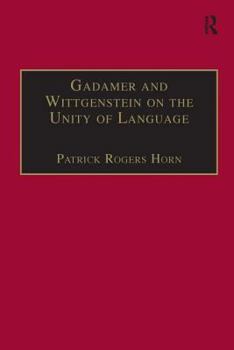
Gadamer and Wittgenstein on the Unity of Language: Reality and Discourse Without Metaphysics
No Customer Reviews

Select Format
Select Condition 
Book Overview
In this innovative comparison of Gadamer and Wittgenstein, the author explores their common concern with the relation of language to reality. Patrick Horn's starting point is the widely accepted view that both philosophers rejected a certain metaphysical account of that relation in which reality determines the nature of language. Horn proceeds to argue that Gadamer never completely escaped metaphysical assumptions in his search for the unity of language. In this respect, argues Horn, Gadamer's work is nearer to the earlier rather than to the later Wittgenstein. The final chapter of the book highlights the work of Wittgenstein's pupil Rush Rhees, who shows that Wittgenstein's own later emphasis on language games, while doing justice to the variety of language, does less than justice to the dialogical relation between speakers of a language, wherein the unity of language resides. Contrasting Rhees's account of the unity of language with those given by Gadamer and the early Wittgenstein brings out the importance of understanding reality in terms of the life that people share rather than in terms of what philosophers say about reality.
Format:Hardcover
Language:English
ISBN:0754609693
ISBN13:9780754609698
Release Date:June 2005
Publisher:Routledge
Length:152 Pages
Weight:0.85 lbs.
Dimensions:0.7" x 6.4" x 9.3"
Related Subjects
PhilosophyCustomer Reviews
0 rating
Copyright © 2026 Thriftbooks.com
Terms of Use | Privacy Policy | Do Not Sell/Share My Personal Information | Cookie Policy | Cookie Preferences | Accessibility Statement
ThriftBooks ® and the ThriftBooks ® logo are registered trademarks of Thrift Books Global, LLC
ThriftBooks ® and the ThriftBooks ® logo are registered trademarks of Thrift Books Global, LLC
