


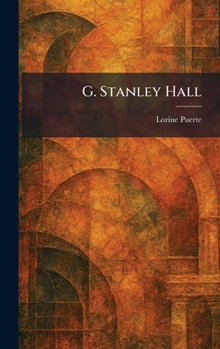
G. Stanley Hall

"G. Stanley Hall" is a compelling and scholarly biography that examines the life and intellectual contributions of one of the most foundational figures in American psychology. Written by Lorine Puerte and published shortly after Hall's death, this work provides an intimate look at the man who served as the first president of the American Psychological Association and the founding president of Clark University.
The book details Hall's pioneering research into child development and his revolutionary theories regarding adolescence and senescence. By exploring his academic journey and his role in establishing the "American Journal of Psychology", Puerte highlights how Hall's work helped transition the study of the human mind from philosophical speculation into a rigorous scientific discipline. The narrative captures the essence of a visionary whose influence extended into educational reform and the professionalization of social sciences in the United States.
Suitable for historians, psychologists, and educators, "G. Stanley Hall" serves as a vital record of a scholar who redefined the understanding of human growth across the lifespan. It stands as a testament to Hall's enduring legacy and his role in shaping the modern landscape of psychological inquiry.
This work has been selected by scholars as being culturally important, and is part of the knowledge base of civilization as we know it. This work was reproduced from the original artifact, and remains as true to the original work as possible. Therefore, you may see the original copyright references, library stamps (as most of these works have been housed in our most important libraries around the world), and other notations in the work.
This work is in the public domain in the United States of America, and possibly other nations. Within the United States, you may freely copy and distribute this work, as no entity (individual or corporate) has a copyright on the body of the work.
As a reproduction of a historical artifact, this work may contain missing or blurred pages, poor pictures, errant marks, etc. Scholars believe, and we concur, that this work is important enough to be preserved, reproduced, and made generally available to the public. We appreciate your support of the preservation process, and thank you for being an important part of keeping this knowledge alive and relevant.
Customer Reviews
ThriftBooks ® and the ThriftBooks ® logo are registered trademarks of Thrift Books Global, LLC
