


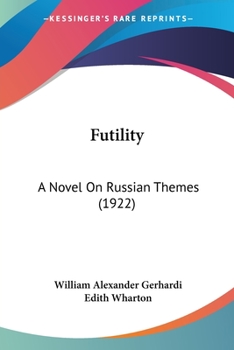
Futility: A Novel On Russian Themes (1922)


Select Format
Select Condition 
Book Overview
Futility: A Novel On Russian Themes is a novel written by William Alexander Gerhardi and first published in 1922. The story is set in Russia during the early 20th century and follows the life of a young man named Andrei Andreievich, who is the heir to a wealthy family. The novel is divided into three parts and explores the themes of love, war, and revolution. In the first part, Andrei falls in love with a young woman named Nina, but their relationship is cut short when Andrei is called to fight in World War I. The second part focuses on Andrei's experiences during the war, including his capture by the Germans and subsequent escape. The final part of the novel takes place during the Russian Revolution and the subsequent Civil War. Andrei returns home to find his family's estate in ruins and his former love, Nina, now married to a Bolshevik. The novel ends with Andrei's realization that his former life is now futile and that he must adapt to the new reality of his country. Futility: A Novel On Russian Themes is known for its vivid descriptions of the Russian landscape and its exploration of the themes of love, war, and revolution. The novel was well-received upon its publication and is now considered a classic of Russian literature.This scarce antiquarian book is a facsimile reprint of the old original and may contain some imperfections such as library marks and notations. Because we believe this work is culturally important, we have made it available as part of our commitment for protecting, preserving, and promoting the world's literature in affordable, high quality, modern editions, that are true to their original work.
Format:Paperback
Language:English
ISBN:1436855551
ISBN13:9781436855556
Release Date:June 2008
Publisher:Kessinger Publishing
Length:264 Pages
Weight:0.79 lbs.
Dimensions:0.6" x 6.0" x 9.0"
Customer Reviews
4 ratings
neglected minor masterpiece
Published by Thriftbooks.com User , 17 years ago
One of my greatest enjoyments in reading is the discovery of idiosyncratic books which have escaped public awareness, but manifest elements of genius; often quirky and flawed. This is the pleasure of the treasure-hunter at having stumbled across something precious among so much that is common and derivative. I would definitely include Gerhardie's book "Futility" in this personal grouping, along with such disparate authors as Robert Aickman who wrote wildly different horror, and David Lindsay who penned the one-of-a-kind "Voyage To Arcturus". The only thing these authors have in common is that they are different from anything else I've read. Gerhardie's novel seems at first to be an amusing farce which belies the bleak connotation of the title. A young Englishman born and educated in pre-revolutionary Russia is gradually initiated into the absurd complexities of a very extended Russian family with whom he becomes acquainted. The patriarch and provider has cascaded his obligations into astronomical proportions by having successively declared his love for three different women. One remains his legal wife, one is an ex-mistress, the other his current mistress. Each of these relationships has brought into Nikolai Vasilievich's domain numerous relatives who continue to look to him for their livelihood. The young Englishman,called Andrei Andreiech, while trying to establish a romantic relationship with one of the attractive daughters becomes involved, sometimes to a degree he regrets, in these complicated affairs. For the most part,though, he maintains a sympathetic but detached observation of the progress of this situation, which actually adds up to no progress at all. The desires, illusions, delusions, expectations and eccentricities of the many players in this drama all seem to add up to nothing but a perpetual waiting for something to happen, or futility. There is a frequent airing out of emotional states reminiscent of Doestoevski's novels but without his oppressive morbidity. So it seems you can label this as an amusing social satire. Then a rather deeper tone makes itself felt. The story enters the period of the revolution. The families remain absorbed in their own local tempest even while the world they knew is being dismantled by outside events. The stupidity and blundering of the leaders and the bloodthirsty rampaging of the mobs drag on and on until there is no longer any possibility of humane solutions. A more universal futility encompasses the localized futility of the family. The narrator maintains his detached-observer attitude, almost to the point of glibness, in the face of such monstrous events. But now, surprisingly, we see our young Englishman begin to occasionally make astute comments about the war, the various personalities he comes in contact with, and life in general. What might have been construed as glibness is really, it seems, a determination to maintain his objectivity in the face of the unbridled irrationality rampant in t
Now I've actually read the book, its wonderful
Published by Thriftbooks.com User , 22 years ago
Now I've read it, I recommend - nay, DEMAND - that every man woman and children in the English speaking world reads this brilliant novel. Waugh said "I have talent, while he has genius" - having read Doom and The Polyglots since, this shows that genius at its best. Highly recommended (obviously) - readers who enjoy Anthony Powell and Waugh will particularly love Gerhardie.
Gerhardie must be in stitches!
Published by Thriftbooks.com User , 22 years ago
No, this is not The Wreck of the Titan, this is the brilliant tragicomedy of Russian life that has inspired so much laughter, tears, and admiration since it was first published in the 1920's. As the subject is the comic hopelessness of love and success, I'm sure the author is very amused (posthumously)to find it mistaken for a book about a shipwreck in all of these reviews. But if you end up here, by mistake or not, do read this book, because it is horribly funny and poignant and true.
Paranormal?
Published by Thriftbooks.com User , 25 years ago
I was told of this book by a friend who claimed that it told the story of the ill fated ship - Titanic but it was wrtten 14 years before Titanic sailed. Strangely enough he was correct. Though the plot is ordinary by today's standards, the eerie feelinge once gets in noticing the similarities between Titanic and th story in this book ensures a top rating.
Copyright © 2026 Thriftbooks.com
Terms of Use | Privacy Policy | Do Not Sell/Share My Personal Information | Cookie Notice | Cookie Preferences | Accessibility Statement
ThriftBooks ® and the ThriftBooks ® logo are registered trademarks of Thrift Books Global, LLC
ThriftBooks ® and the ThriftBooks ® logo are registered trademarks of Thrift Books Global, LLC
