


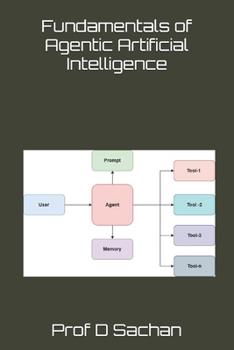
Fundamentals of Agentic Artificial Intelligence
No Customer Reviews

The textbook "Fundamentals of Agentic Artificial Intelligence" is designed as a comprehensive introduction to the evolving domain of Agentic AI, with particular emphasis on its theoretical foundations, architectural principles, applications, and challenges. Organized into eight well-structured chapters, the book guides readers step by step through the fundamental concepts and practical insights necessary to understand and work with agentic systems in academic and professional settings.Chapter 1: Agentic Artificial Intelligence introduces the core idea of agentic systems, distinguishing them from traditional AI models. It provides historical context, motivation for their development, and a survey of the fundamental principles that define agentic intelligence.Chapter 2: Key Characteristics of Agentic AI explores the defining traits of agentic systems such as autonomy, proactivity, adaptability, memory, reasoning, and collaboration. These characteristics are discussed with detailed examples from real-world scenarios to highlight their relevance in practical deployments.Chapter 3: Agentic AI Architecture focuses on the structural design of these systems, examining the layers, components, and frameworks that enable agentic behavior. Topics such as planning modules, memory subsystems, reasoning engines, and communication interfaces are thoroughly covered.Chapter 4: Agentic AI Use Cases in Different Services presents applied perspectives, showcasing how agentic AI is integrated into diverse sectors such as healthcare, telecommunications, finance, logistics, and education. These examples are meant to inspire innovative applications and research directions.Chapter 5: Agentic AI and Agentic Automation analyzes the relationship between agentic intelligence and automation systems. It explains how agentic AI enhances automation by introducing reasoning, adaptability, and human-like decision-making into repetitive workflows.Chapter 6: Agentic AI Lifecycle for Enterprise Processes provides a roadmap for organizations seeking to adopt agentic systems. It covers the stages from design and development to deployment, monitoring, and continuous improvement, with emphasis on governance and scalability.Chapter 7: Workflow of Agentic AI examines the sequential processes involved in agentic systems, such as perception, decision-making, execution, and feedback. Practical examples illustrate how these workflows operate in real-time environments.Chapter 8: Risks and Drawbacks of Agentic AI addresses critical concerns such as ethical implications, security vulnerabilities, reliability issues, and potential social impacts. The discussion balances optimism with caution, encouraging responsible research and implementation.
Prof. D. Sachan
Prof. D. Sachan
Format:Paperback
Language:English
ISBN:B0FXKZ3GSX
ISBN13:9798271272615
Release Date:October 2025
Publisher:Independently Published
Length:146 Pages
Weight:0.45 lbs.
Dimensions:0.3" x 6.0" x 9.0"
Customer Reviews
0 rating
Copyright © 2026 Thriftbooks.com
Terms of Use | Privacy Policy | Do Not Sell/Share My Personal Information | Cookie Policy | Cookie Preferences | Accessibility Statement
ThriftBooks ® and the ThriftBooks ® logo are registered trademarks of Thrift Books Global, LLC
ThriftBooks ® and the ThriftBooks ® logo are registered trademarks of Thrift Books Global, LLC
