


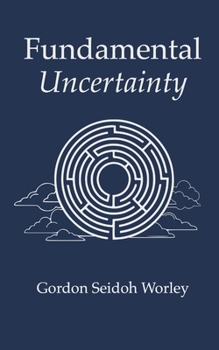
Fundamental Uncertainty

How do you know what's true? And what happens when you can't be sure?
We use truth every day-to make decisions, settle arguments, and understand the world. But most of us have never looked closely at how we know what we know. When we do, we find something unsettling: the foundations of our knowledge rest on assumptions we can't justify.
In Fundamental Uncertainty, Gordon Seidoh Worley traces this problem from its roots in ancient philosophy to its consequences for the modern world. Drawing on epistemology, cognitive science, cybernetics, and evolutionary psychology, he builds a careful argument that all knowledge is fundamentally uncertain-not because we're bad at reasoning, but because the very structure of knowledge demands unjustified starting points.
But we need not despair, for Worley goes on to show that truth is grounded in what we care about, and that understanding this changes how we see some of the world's hardest problems, from the culture war to the meaning crisis to the existential risks posed by artificial intelligence.
Written for readers with a technical background and a taste for big questions, Fundamental Uncertainty is an approachable, carefully argued book that asks you to rethink what you thought you knew about knowing. If you've ever stayed up too late arguing with a stranger on the internet about what's really true, this book is for you.
Customer Reviews
ThriftBooks ® and the ThriftBooks ® logo are registered trademarks of Thrift Books Global, LLC
