


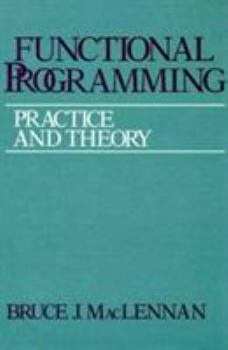
Functional Programming: Practice and Theory

Select Format
Select Condition 
Book Overview
This book is more than an introduction to programming in functional languages; it introduces functional programming as a new programming paradigm. Its focus is on functional programming... This description may be from another edition of this product.
Format:Paperback
Language:English
ISBN:0201137445
ISBN13:9780201137446
Release Date:January 1990
Publisher:Addison-Wesley Professional
Length:608 Pages
Weight:2.02 lbs.
Dimensions:1.2" x 6.6" x 9.5"
Customer Reviews
1 rating
Mathematical notation-based approach
Published by Thriftbooks.com User , 26 years ago
The author utilizes mathematical notation rather than suffering through the inevitable inadequacies and limitations of any particular language (LISP, ML, Haskell, ..) However this actually simplifies the instruction, assuming the reader is familiar with set theory and the basics of formal logic.The illustrations are primarily of the kind familiar to anyone involved in computer science, such as parse trees, flowcharts, and schematics of memory allocation. There are also mathematical type signatures.Program examples include [very] infrequent ones in LISP, as well as occasional procedural examples given in antiquated-yet-adequate Pascal.For the purpose of general instruction this may well be unexcelled in the field. Upon completion the reader will have a better underlying understanding of any particular functional language than peers who have been programming in one ad-hoc for a substantially longer time. Many of the general topics are fundamental to other language paradigms as well, including procedural and object-orientation (of which the author is an expert and contributor). Of particular note are the topics of recursion, binding, and computability issues, as discussed using the lambda calculus.This is an extremely clear work, systematically covering subjects ranging through logic, computing and math without drawing any attention to distinctions between them. Throughout, it maintains a complete focus upon functional programming. In this way there is a satisfying flow to the book, allowing the incredibly rich and fine detail to be better understood in context.It is important to take note that this work does not merely teach the reader about programming in a functional language. Many tangent subjects will become familiar in the process, including some which may have previously been a source of intimidation. And, as programming languages evolve, such a foundation will prove over time to be an invaluable resource.
Copyright © 2026 Thriftbooks.com Terms of Use
| Privacy Policy | Do Not
Sell/Share My Personal Information | Cookie Policy | Cookie Preferences | Accessibility Statement
ThriftBooks® and the ThriftBooks® logo are registered trademarks of Thrift Books Global, LLC
ThriftBooks® and the ThriftBooks® logo are registered trademarks of Thrift Books Global, LLC
