


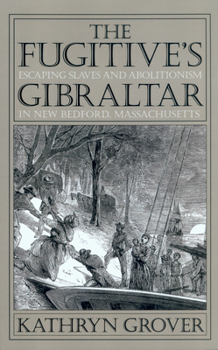
The Fugitive's Gibraltar: Escaping Slaves and Abolitionism in New Bedford, Massachusetts

The Fugitive's Gibraltar is a richly researched work of social and cultural history that examines the city of New Bedford, Massachusetts as one of the most important and welcoming refuges for freedom-seeking enslaved people in antebellum America. The book's title derives from the phrase used by Frederick Douglass--himself among the most famous of New Bedford's many fugitive residents--to describe the city's reputation as a place of relative safety and freedom for Black Americans fleeing enslavement in the South.
Grover draws on an extraordinary breadth of primary sources to reconstruct the lives of fugitive slaves who came to New Bedford before the Civil War, as well as the city's larger African American community and the white and Black abolitionists who worked alongside them. The book explores how New Bedford's booming whaling economy--which depended heavily on Black labor and offered Black sailors wages equal to those of white sailors--created economic and social conditions unusually hospitable to free and freedom-seeking Black people. New Bedford's maritime character is thus deeply intertwined with its abolitionist identity.
The work examines the networks of people and organizations that sheltered, employed, and advocated for fugitives; traces individual stories of escape and resettlement; and situates New Bedford's experience within the broader national struggle over slavery, the Fugitive Slave Acts, and the abolitionist movement. Notable figures discussed include Frederick Douglass and Henry "Box" Brown. The book also sheds light on the daily lives, livelihoods, and community institutions of New Bedford's African American population--their churches, mutual aid societies, and social networks--providing a nuanced portrait of Black life in a northern city during this turbulent era.
Customer Reviews
ThriftBooks ® and the ThriftBooks ® logo are registered trademarks of Thrift Books Global, LLC
