


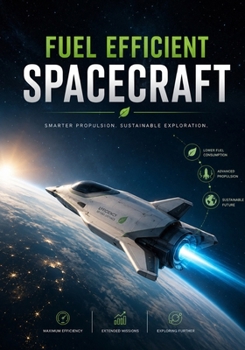
Fuel Efficient Spacecraft

Fuel Efficient Spacecraft is a comprehensive exploration of one of the most fundamental challenges in space exploration how to travel farther, accomplish more, and reach destinations that would otherwise remain forever out of reach, all while carrying less propellant than the mission seems to demand. Beginning with Tsiolkovsky's rocket equation and its unforgiving arithmetic, the book traces the complete arc of propulsion science from the earliest chemical rockets through ion engines, solar sails, nuclear propulsion, and the exotic concepts that current physics permits but existing engineering cannot yet build. Each chapter peels back a layer of the efficiency problem propulsion systems, trajectory design, structural materials, thermal management, autonomous navigation, and mission architecture revealing how every engineering discipline in spacecraft design connects back to the fundamental challenge of doing more with less. The missions of Deep Space 1, Dawn, Hayabusa, and BepiColombo are examined not as historical curiosities but as proof of concept demonstrations that patience and efficiency can accomplish what brute force cannot. The Lunar Gateway, the Artemis architecture, and the challenge of a crewed Mars mission are analyzed through the lens of what genuine fuel efficiency demands of human spaceflight. In-space propellant depots, beamed energy systems, fusion drives, and antimatter propulsion are treated not as science fiction but as engineering directions grounded in known physics, with honest assessments of where each stands today and what it would take to make each operational. Throughout, the book argues that efficiency in spaceflight is not merely a technical concern but a philosophy a way of engaging with physical reality that rewards deep understanding over brute force, patience over immediacy, and working with the universe's natural structure rather than against it. Written for readers who take the science seriously without requiring specialist training, Fuel Efficient Spacecraft makes the case that the most important question in the future of space exploration is not how powerful our rockets can become but how intelligently we can learn to use the energy we have.
Related Subjects
Engineering Science Science & Math Science & Scientists Science & Technology TechnologyCustomer Reviews
ThriftBooks ® and the ThriftBooks ® logo are registered trademarks of Thrift Books Global, LLC
