


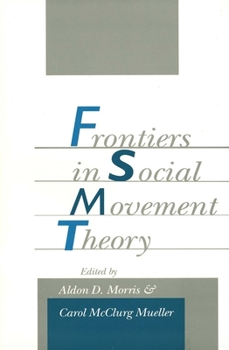
Frontiers in Social Movement Theory

Select Format
Select Condition 
Book Overview
Social protest movements such as the civil rights movement and the gay rights movement mobilize and sustain themselves in ways that have long been of interest to social scientists. In this book some of the most distinguished scholars in the area of collective action present new theories about this process, fashioning a rich and conceptually sophisticated social psychology of social movements that goes beyond theories currently in use. The book includes sometimes competing, sometimes complementary paradigms by theorists in resource mobilization, conflict, feminism, and collective action and by social psychologists and comparativists. These authors view the social movement actor from a more sociological perspective than do adherents of rational choice theory, and they analyze ways in which structural and cultural determinants influence the actor and generate or inhibit collective action and social change. The authors state that the collective identities and political consciousness of social movement actors are significantly shaped by their race, ethnicity, class, gender, or religion. Social structure--with its disparities in resources and opportunities--helps determine the nature of grievances, resources, and levels of organization. The book not only distinguishes the mobilization processes of consensus movements from those of conflict movements but also helps to explain the linkages between social movements, the state, and societal changes.
Format:Paperback
Language:English
ISBN:0300054866
ISBN13:9780300054866
Release Date:August 1992
Publisher:Yale University Press
Length:400 Pages
Weight:1.41 lbs.
Dimensions:1.2" x 6.1" x 9.2"
Customer Reviews
1 rating
Protest, Activism & Social Movements
Published by Thriftbooks.com User , 17 years ago
"Social protest movements such as the civil rights movement and the gay rights movement mobilize and sustain themselves in ways that have long been of interest social scientists. In this book some of the most distinguished scholars in the area of collective action presents new theories about this process, fashioning a rich and conceptually sophisticated social psychology of social movements that goes beyond theories currently in use. This book includes sometimes competing, sometimes complementary paradigms by theorists in resource mobilization, conflict feminism, and collective action and by social psychologists and comparatives. These authors view the social movement actor from a more sociological perspective than do adherents of rational choice theory, and they analyze ways in which structural and cultural determinants influence the actor and generate or inhibit collective action and social change. The authors state that the collective identifies and political consciousness of social movement actors are significantly shaped by their race, ethnicity, class, gender, or religion. Social structure - with the disparities in resources and opportunities - helps determine the nature of grievances, resources, and levels of organization. The book not only distinguishes the mobilization processes of consensus movements from those of conflict movements but also helps to explain the linkages between social movements, the state, and societal changes." From Table of Contents: PART I: Introduction 1 - Building Social Movement theory - Carol Mueller PART II: Social Psychology of Social Movements * The Political Context of Rationality: Rational Choice Theory and Resource Mobilization - [M. M. Feree] * The Social Psychology of Collective Action - William Gamson * The Social Construction of Protest and Multiorganizational Fields (B. Klandermans) * Collective Identity in Social Movement Communities: Lesbian Feminist Mobilization (Verta Taylor; Nancy Whittier] PART III: Socio-political Culture and the Persuasive Communications of Social Movement Organization * Master Frames and Cycles of Protest (David Snow & Robert Benford) * Collective Identity Activism: Network, Choices, and the Life of a Social Movement (D. Friedman & Doug McAdam) * Mentalities, Popular Cultures, and Collective Action Frames: Constructing Meanings through Action (Sidney Tarrow) PART IV: CONFLICT, COMMUNITY, AND MOBILIZATION * Resource Mobilization versus the Mobilization of People: Why Consensus Movements Cannot Be Instruments of Social Change (M. Schwartz & Shuva Paul) * Communities of Challengers in Social Movement Theory (Clarence Y.H. Lo) PART V: MOBILIZATION, QUIESCENCE, AND CONSENSUS * Mobilization Technologies of Collective Action (P. Oliver & Gerald Marwell) * Consensus Movements, Conflict Movements, and the Cooptation of Civic and State Infrastructures (John McCarthy & Mark Wolfson) PART VI: WHEN PARADIGMS COLLIDE: RESOURCE MOBILIZATION VERSUS BREAKDOWN
Copyright © 2026 Thriftbooks.com
Terms of Use | Privacy Policy | Do Not Sell/Share My Personal Information | Cookie Policy | Cookie Preferences | Accessibility Statement
ThriftBooks ® and the ThriftBooks ® logo are registered trademarks of Thrift Books Global, LLC
ThriftBooks ® and the ThriftBooks ® logo are registered trademarks of Thrift Books Global, LLC
