


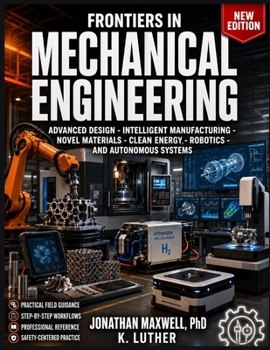
Frontiers in Mechanical Engineering: Advanced Design, Intelligent Manufacturing, Novel Materials, Clean Energy, Robotics, and Autonomous Systems

Mechanical engineering is rapidly evolving beyond conventional machines and manufacturing methods. Today's engineers must understand how advanced computation, intelligent production, emerging materials, low-carbon energy systems, robotics, and autonomous technologies interact within complete engineering systems.
Frontiers in Mechanical Engineering is a rigorous, application-focused reference that connects established mechanical-engineering principles with the technologies transforming modern design, manufacturing, energy conversion, and industrial automation.
Written for upper-level engineering students, postgraduate researchers, practising engineers, designers, manufacturing specialists, and technical professionals, this comprehensive volume explains how emerging technologies can be evaluated, modelled, manufactured, tested, validated, and prepared for responsible deployment.
The book begins with the methods required to assess frontier engineering research, including technology readiness, uncertainty, verification, validation, scalability, manufacturability, and systems integration. It then develops a progressive technical treatment of:
Multiphysics modelling and high-fidelity simulationGenerative design and topology optimisationDigital twins and model-based engineeringAdvanced materials, composites, and metamaterialsSmart materials and adaptive structuresAdditive, hybrid, and reconfigurable manufacturingIntelligent manufacturing and cyber-physical productionPrecision engineering, metrology, and data-driven qualitySustainable design and circular manufacturingAdvanced thermal-fluid systems and energy conversionHydrogen, fuel cells, and energy-storage technologiesRobotic mechanisms and compliant actuationMachine intelligence and industrial automationAutonomous mechanical systemsIntegrated frontier applications and future research directionsRather than presenting emerging technology as isolated theory, the book shows how each concept becomes an engineering decision. Equations are developed with defined variables, assumptions, and SI units. Worked examples demonstrate complete calculations, while practice problems reinforce modelling, design, manufacturing, energy, materials, robotics, and automation skills.
Readers will learn how to distinguish numerical convergence from physical validation, nominal optimisation from robust design, experimental novelty from deployable value, and attractive digital output from trustworthy engineering evidence.
Additional reference materials include a glossary, material and failure-data guidance, thermal-fluid calculation tables, robotics and automation worksheets, technology-readiness checklists, consolidated standards guidance, and a detailed index.
Whether used as a university textbook, postgraduate research reference, professional engineering manual, or interdisciplinary technology guide, Frontiers in Mechanical Engineering provides a practical framework for understanding, designing, and validating the mechanical systems shaping the future.
Customer Reviews
ThriftBooks ® and the ThriftBooks ® logo are registered trademarks of Thrift Books Global, LLC
