


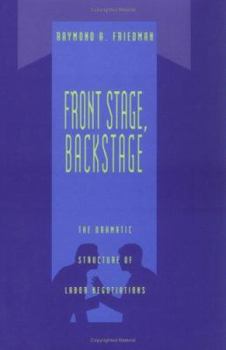
Front Stage, Backstage: The Dramatic Structure of Labor Negotiations (Organization Studies)
No Customer Reviews

Select Format
Select Condition 
Book Overview
In this carefully detailed and rigorous study of the social processes of labor negotiations, the author uncovers the pressures and motivations felt by negotiators, showing why the bargaining process persists largely in its traditional form despite frequent calls for change. Raymond Friedman approaches labor negotiations with a conviction that negotiators are situated in a social network that greatly influences bargaining styles. In this carefully detailed and rigorous study of the social processes of labor negotiations, he uncovers the pressures and motivations felt by negotiators, showing why the bargaining process persists largely in its traditional form despite frequent calls for change. Friedman first focuses on the social structure of labor negotiations and the logic of the traditional negotiation process. He then looks at cases where the traditional rituals of negotiation were set aside and new forms emerged and, in the light of these examples, addresses the options for and obstacles to change.In an unusual twist Friedman describes the persistence of the traditional negotiation process by developing a dramaturgical theory in which negotiators are seen as actors who perform for teammates, constituents, and opponents. They try to convince others of their skill, loyalty, and dedication, while others expect them to play the role of opponent, representative, and leader. Friedman shows that the front-stage drama fulfills these needs and expectations, while backstage contacts between lead bargainers allow the two sides to communicate in private. The traditional labor negotiation process, he reveals, is an integrated system that allows for both private understanding and public conflict. Current efforts to change how labor and management negotiate are limited by the persistence of these roles, and are bound to fail if they do not account for the benefits as well as the flaws of the traditional rituals of negotiation. For negotiation scholars, Friedman's perspective provides an alternative to the rational-actor models that dominate the field; his dramaturgical theory is applicable to any negotiations done by groups, especially ones that face political pressures from constituents. For labor scholars, this is the first integrated theory of the negotiation process since Walton and McKersies's classic text, and one that helps unite the four elements of their model. For sociologists, the book provides an example of how a dramaturgical perspective can be used to explain the logic and persistence of a social institution. And practitioners will appreciate this explanation of why change is so difficult. Organization Studies series
Format:Hardcover
Language:English
ISBN:0262061678
ISBN13:9780262061674
Release Date:May 1994
Publisher:Mit Pr
Length:271 Pages
Weight:0.85 lbs.
Dimensions:9.5" x 0.8" x 6.5"
Age Range:18 years and up
Grade Range:Postsecondary and higher
Customer Reviews
0 rating
Copyright © 2026 Thriftbooks.com Terms of Use
| Privacy Policy | Do Not
Sell/Share My Personal Information | Cookie Policy | Cookie Preferences | Accessibility Statement
ThriftBooks® and the ThriftBooks® logo are registered trademarks of Thrift Books Global, LLC
ThriftBooks® and the ThriftBooks® logo are registered trademarks of Thrift Books Global, LLC
