


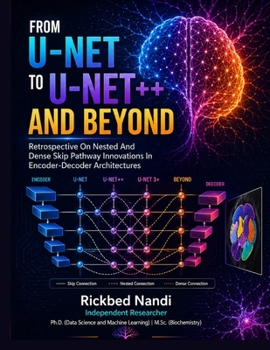
From U-NET to U-NET++ and Beyond: A Critical Retrospective on Nested and Dense Skip Pathway Innovations in Encoder-Decoder Architectures
No Customer Reviews

The U-Net architecture has shaped the trajectory of dense-prediction computer vision for over a decade since its introduction in 2015. Among its descendants, U-Net++ stands out as a foundational reformulation that replaced plain encoder-to-decoder skip connections with a nested grid of densely connected convolution blocks designed to bridge the persistent semantic gap between encoder features and decoder reconstruction. This article presents a comprehensive critical retrospective spanning 11 years (2015-2026) of nested and dense skip-pathway innovations and situates U-Net++ within the broader phylogeny of encoder-decoder networks. A primary multi-source dataset compiled by the author and consisting of 28 worksheets and approximately 152,000 records was analysed using a mixed-method design, integrating descriptive bibliometric analysis, hierarchical Beta-regression on Dice score distributions, ablation-axis meta-analysis with inverse-variance pooling, Pareto-frontier extraction, and class-imbalance long-tail correlation. The empirical record demonstrates that U-Net++ delivers 1.74 to 6.67%-point IoU improvements over plain U-Net under matched conditions, that depth-pruned variants attain a 74% inference speedup with only marginal accuracy loss, and that boundary-aware and compound loss functions provide consistent yet quantitatively modest aggregate gains (mean +1.86 and +0.96 Dice points, respectively). The retrospective further establishes that the central design principle of U-Net++, namely the bridging of the semantic gap, has not been abandoned by the third generation of transformer-based and the fourth generation of state-space-based segmenters but has instead been reformulated through cross-attention skip modules, frequency-domain skip filtering, and Mamba-guided fusion. The article additionally maps the propagation of U-Net++ ideas into adjacent computer-vision applications relevant to cybersecurity, including biometric segmentation, image-splicing localisation, satellite change detection, and adversarial-robustness research. The findings provide a quantitative substrate for theoretical claims about nested skip-pathway efficacy, identify ten specific research gaps, and suggest concrete avenues for the next generation of skip-pathway design.
Format:Paperback
Language:English
ISBN:B0GZ6GQFP7
ISBN13:9798259486874
Release Date:April 2026
Publisher:Independently Published
Length:66 Pages
Weight:0.52 lbs.
Dimensions:0.2" x 8.5" x 11.0"
Customer Reviews
0 rating
Copyright © 2026 Thriftbooks.com
Terms of Use | Privacy Policy | Do Not Sell/Share My Personal Information | Cookie Notice | Cookie Preferences | Accessibility Statement
ThriftBooks ® and the ThriftBooks ® logo are registered trademarks of Thrift Books Global, LLC
ThriftBooks ® and the ThriftBooks ® logo are registered trademarks of Thrift Books Global, LLC
