


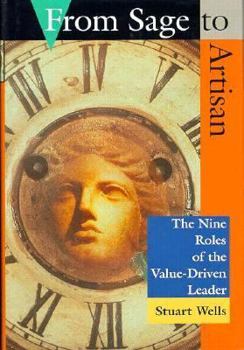
From Sage to Artisan: The Nine Roles of the Value-Driven Leader

Select Format
Select Condition 
Book Overview
This volume describes nine leadership roles - Sage, Visionary, Magician, Globalist, Mentor, Ally, Sovereign, Guide and Artisan - that play a part in every organization. It provides hands-on exercises,... This description may be from another edition of this product.
Format:Hardcover
Language:English
ISBN:0891060936
ISBN13:9780891060932
Release Date:January 1997
Publisher:UNKNO
Length:304 Pages
Weight:1.45 lbs.
Dimensions:9.3" x 1.1" x 6.4"
Related Subjects
Business Business & Investing Economics Leadership Management Management & LeadershipCustomer Reviews
1 rating
a valuable typology of leadership roles
Published by Thriftbooks.com User , 25 years ago
Every now and then there is a book that a reviewer can wholeheartedly recommend as being both practical and a genuine contribution to the way in which we think and act. This is one of them. It offers an extremely valuable typology with which to think about and develop the leadership role, based firmly on the imperative of a solid basis of core values. An invaluable tool for developing the leadership function in organisations and skills in individuals.Stuart Wells offers a deceptively simple and very rich framework for thinking about the leadership function and for building personal and organisational leadership capacity, consisting of nine management roles, framed within three foci of managerial effort and three principal leadership processes. The whole of the book is an explanation and elaboration of the model.Points to notice about the model are:* first, that the explicit articulation and demonstration of a coherent set of core values lies at the base of the effectiveness of all the roles;* second, that the author is concerned with roles, all of which contribute in different ways to the success of the organisation, that collectively make a difference to organisational success and that may be exercised cooperatively by different people within a team or group. The model is not about the superhuman abilities of the 'hero' leader;* third, that each role lies at the intersection between one of three leadership processes and three foci of managing effort - at different times and in different situations different combinations of roles may be critical to moving forward. Each role is itself distinctive and different from the others;* fourth that the nine roles are learnable, but that in each individual they will be differentially developed and each individual with have natural preferences, strengths and weaknesses. The model is focused on observable roles and their impact, rather than on: * the inner qualities of a leader (eg Jaworski 'Synchronicity'), * the stance of a leader in relation to the authoritarian/participative continuum (eg Bower 'The Will to Lead'), or * the way in which a network of leadership may be developed within an organisation (e.g. Senge: 'The Dance of Change'). These different perspectives are complementary to each other. Wells' distinctive contribution is to separate the discussion of important and continuing roles from the mythology of the 'hero' leader that is implicit or explicit in so much writing about leadership.The author's claims for the book are modest. He explicitly recognises that leadership is learned from practice, not from books and he offers the book as a guide to self assessment and a guide to building practice and confidence in each role.
Copyright © 2026 Thriftbooks.com Terms of Use
| Privacy Policy | Do Not
Sell/Share My Personal Information | Cookie Policy | Cookie Preferences | Accessibility Statement
ThriftBooks® and the ThriftBooks® logo are registered trademarks of Thrift Books Global, LLC
ThriftBooks® and the ThriftBooks® logo are registered trademarks of Thrift Books Global, LLC
