


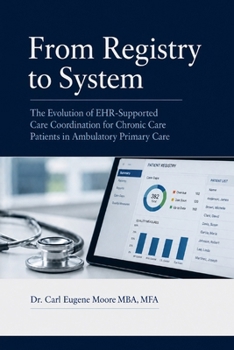
From Registry to System: The Evolution of EHR-Supported Care Coordination for Chronic Care Patients in Ambulatory Primary Care
No Customer Reviews

This monograph examines whether an electronic chronic care registry improved health quality outcomes for diabetes patients in ambulatory primary care. The empirical foundation is a quantitative retrospective study of 329 diabetes patients in a large family medicine practice in the South Carolina midlands, comparing clinical and process measures from 2012, before the registry was in place, with measures from 2015, after nearly three years of use. Analysis by multivariate analysis of variance and paired samples t-tests found no statistically significant improvement in hemoglobin A1c, low-density lipoprotein, systolic blood pressure, or microalbumin. Over the same period, documented diabetic foot examinations rose 513.8 percent and documented dilated retinal eye examinations rose 486.7 percent. Read through Donabedian's structure-process-outcome framework, the chain held from structure to process and broke between process and outcome. This monograph suggests that the registry was a necessary first step and an insufficient one, that the variables mediating between clinical process and patient outcome lie beyond the reach of any single tool, and that the layered model the field assembled around the registry represents its evolving answer to a problem the registry exposed but could not solve.
Format:Paperback
Language:English
ISBN:B0HJF6D3M5
ISBN13:9798187539130
Release Date:September 2026
Publisher:Independently Published
Length:110 Pages
Weight:0.35 lbs.
Dimensions:0.2" x 6.0" x 9.0"
Customer Reviews
0 rating
Copyright © 2026 Thriftbooks.com
Terms of Use | Privacy Policy | Do Not Sell/Share My Personal Information | Cookie Notice | Cookie Preferences | Accessibility Statement
ThriftBooks ® and the ThriftBooks ® logo are registered trademarks of Thrift Books Global, LLC
ThriftBooks ® and the ThriftBooks ® logo are registered trademarks of Thrift Books Global, LLC
