


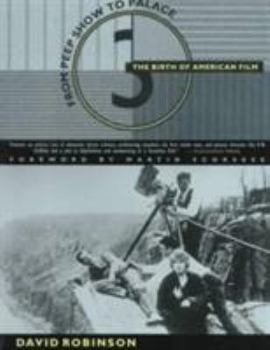
From Peepshow to Palace: The Birth of American Film


Select Format
Select Condition 
Book Overview
Film critic David Robinson chronicles the early use of film as vaudeville sideshow; as sheer spectacle of moving images precluding any notion of plot development or drama; and as a fledgling dramatic effort, ranging from prizefights to Passion plays. He also takes readers to the nickelodeon theaters, and replete with more than 150 drawings and photographs, shows how the earliest devices of cinematic prehistory--machines with colorful names like the Phantascope and the Wheel of Life--led to the technology of filmmaking we know today.
Format:Paperback
Language:English
ISBN:0231103395
ISBN13:9780231103398
Release Date:April 1997
Publisher:Columbia University Press
Length:248 Pages
Weight:0.66 lbs.
Dimensions:0.5" x 7.0" x 9.1"
Grade Range:Postsecondary and higher
Customer Reviews
1 rating
Good Overview
Published by Thriftbooks.com User , 16 years ago
This book is hardly new, having been published in 1996. However, given that it is a potted history of the first two decades of since cinema, 1983 through 1913, this should hardly be troublesome. Since I have just read the book for the second time, and given there are no other comments (and taking into account that the title can be bought secondhand for under $2!) I thought a word or two might help encourage someone to pick it up. The main text of this book runs for a little over 170 pages. There are many lavish illustrations and pictures, including color inserts in the mid-section. The book sets out to document the rise of moving pictures from their very earliest origins (such as magic laterns) to the epics of GW Griffith. Since the first documented Magic Lantern apears to be from 1420, you can see that the book starts at the very beginning of what can be considered moving projected images for entertainment. By 1893 the likes of Edison and his company were set on their way to defining, and refining what we know as cinema today. The book covers developments quite well, and while there are books out there that have more detail, it can be advantageous to have a title such as this that condenses the topic for an educated overview. The stories told here include technological developments, patent litigations, the rise of the Nickleodean, the rise of multi-reel films, the development of a star system, the Director, the photographer, experiments in sound and color, the development of marketing campaigns, the cinema poster, the import of movies from and to Europe, and the effects of the First World War on film production. It's quite a canvas to cover in so few pages, but for me that is the beauty of this volume, short, concise, and to the point. I'd recommend this as a starting point for people interested in the development of motion pictures. If you want more detail you can get other titles later, but as an introduction, this serves well.
Copyright © 2026 Thriftbooks.com Terms of Use
| Privacy Policy | Do Not
Sell/Share My Personal Information | Cookie Policy | Cookie Preferences | Accessibility Statement
ThriftBooks® and the ThriftBooks® logo are registered trademarks of Thrift Books Global, LLC
ThriftBooks® and the ThriftBooks® logo are registered trademarks of Thrift Books Global, LLC
