


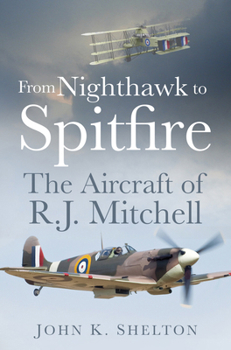
From Nighthawk to Spitfire: The Aircraft of R.J. Mitchell
No Customer Reviews

Select Format
Select Condition 
Book Overview
R. J. Mitchell was virtually self-taught; surprisingly, almost all his other aircraft 24 aircraft were slow-flying seaplanes. How a lad from the land-locked Midlands, apprenticed to a locomotive works, came to be responsible for the Spitfire is a great tale in itself. This detailed book tells us how Mitchell learned his trade--from 1916, contributing to the production of the cumbersome Night Hawk, designed to combat the German Zeppelin threat, and gradually coming to produce record-breaking racing floatplanes which in 1931 won outright the prestigious international Schneider Trophy. Mitchell was thus well placed to design a high speed aircraft when war began to threaten, but Dr. Shelton reveals the production of the famous fighter was by no means a certainty and how, indeed, its vital contribution to winning the Battle of Britain was "a very close run thing."
Format:Paperback
Language:English
ISBN:0750962224
ISBN13:9780750962223
Release Date:July 2015
Publisher:History Press
Length:208 Pages
Weight:1.00 lbs.
Dimensions:0.6" x 6.2" x 9.1"
Related Subjects
Biographical Biographies Biographies & History Biography & History History TransportationCustomer Reviews
0 rating
Copyright © 2026 Thriftbooks.com
Terms of Use | Privacy Policy | Do Not Sell/Share My Personal Information | Cookie Policy | Cookie Preferences | Accessibility Statement
ThriftBooks ® and the ThriftBooks ® logo are registered trademarks of Thrift Books Global, LLC
ThriftBooks ® and the ThriftBooks ® logo are registered trademarks of Thrift Books Global, LLC
