


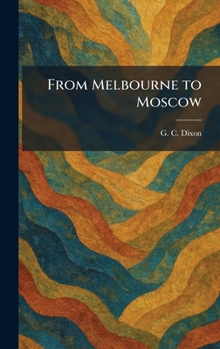
From Melbourne to Moscow

"From Melbourne to Moscow" is an engaging and insightful travelogue penned by Australian journalist G.C. Dixon. Documenting an expansive journey undertaken in the mid-1920s, the work follows Dixon as he travels from Australia through the heart of East Asia-including stops in Japan, China, and Korea-before embarking on the legendary Trans-Siberian Railway toward the Soviet capital.
Dixon provides a vivid, firsthand account of a world in transition. His observations capture the complex political climates and cultural shifts of the interwar period, offering a unique perspective on the early years of the Soviet Union and the evolving societies of the Far East. The narrative is marked by a keen journalistic sensibility, blending personal anecdote with sharp social commentary on the people and places encountered along the way.
As a historical record, "From Melbourne to Moscow" is a valuable resource for understanding the geopolitical landscape of the early 20th century. It stands as a testament to the spirit of adventure and the enduring power of cross-continental travel to bridge disparate cultures. This work is essential reading for those interested in historical travel literature and the social history of the 1920s.
This work has been selected by scholars as being culturally important, and is part of the knowledge base of civilization as we know it. This work was reproduced from the original artifact, and remains as true to the original work as possible. Therefore, you may see the original copyright references, library stamps (as most of these works have been housed in our most important libraries around the world), and other notations in the work.
This work is in the public domain in the United States of America, and possibly other nations. Within the United States, you may freely copy and distribute this work, as no entity (individual or corporate) has a copyright on the body of the work.
As a reproduction of a historical artifact, this work may contain missing or blurred pages, poor pictures, errant marks, etc. Scholars believe, and we concur, that this work is important enough to be preserved, reproduced, and made generally available to the public. We appreciate your support of the preservation process, and thank you for being an important part of keeping this knowledge alive and relevant.
Customer Reviews
ThriftBooks ® and the ThriftBooks ® logo are registered trademarks of Thrift Books Global, LLC
