


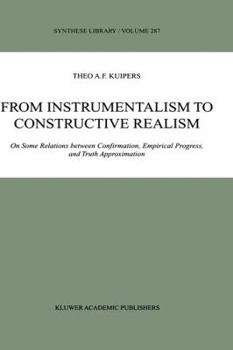
From Instrumentalism to Constructive Realism: On Some Relations Between Confirmation, Empirical Progress, and Truth Approximation
No Customer Reviews

Select Format
Select Condition 
Book Overview
Surprisingly, modified versions of the confirmation theory (Carnap and Hempel) and truth approximation theory (Popper) turn out to be smoothly sythesizable. The glue between the two appears to be the instrumentalist methodology, rather than that of the falsificationalist. The instrumentalist methodology, used in the separate, comparative evaluation of theories in terms of their successes and problems (hence, even if already falsified), provides in theory and practice the straight road to short-term empirical progress in science ( ? la Laudan). It is also argued that such progress is also functional for all kinds of truth approximation: observational, referential, and theoretical. This sheds new light on the long-term dynamics of science and hence on the relation between the main epistemological positions, viz., instrumentalism (Toulmin, Laudan), constructive empiricism (Van Fraassen), referential realism (Hacking, Cartwright), and theory realism of a non-essentialist nature (constructive realism ? la Popper). Readership: Open minded philosophers and scientists. The book explains and justifies the scientist's intuition that the debate among philosophers about instrumentalism and realism has almost no practical consequences.
Format:Hardcover
Language:English
ISBN:0792360869
ISBN13:9780792360865
Release Date:February 2000
Publisher:Springer
Length:372 Pages
Weight:1.58 lbs.
Dimensions:0.9" x 6.1" x 9.2"
Customer Reviews
0 rating
Copyright © 2026 Thriftbooks.com Terms of Use
| Privacy Policy | Do Not
Sell/Share My Personal Information | Cookie Policy | Cookie Preferences | Accessibility Statement
ThriftBooks® and the ThriftBooks® logo are registered trademarks of Thrift Books Global, LLC
ThriftBooks® and the ThriftBooks® logo are registered trademarks of Thrift Books Global, LLC
