


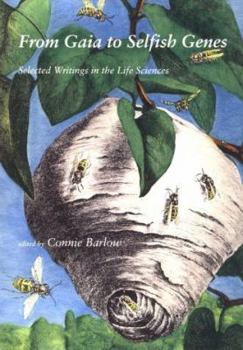
From Gaia to Selfish Genes: Selected Writings in the Life

Select Format
Select Condition 
Book Overview
In a well-blended presentation, writings from more than 30 scientists and science writers span scales from the biosphere to the cell to DNA, encompass disciplines from global ecology to behavior and genetics, and explore links between biology and philosophy.Connie Barlow is a science writer.
Format:Hardcover
Language:English
ISBN:0262023237
ISBN13:9780262023238
Release Date:May 1991
Publisher:Mit Pr
Length:285 Pages
Weight:3.25 lbs.
Dimensions:10.3" x 0.8" x 7.3"
Age Range:18 years and up
Grade Range:Postsecondary and higher
Customer Reviews
1 rating
From planetary entity to mighty molecules
Published by Thriftbooks.com User , 23 years ago
Few scientific ideas have gained as much interest and acclaim as James Lovelock's suggestion of Gaia - the entire Earth views as a single organism. Connie Barlow's own reaction is as good an example as any, stating she could return to a childhood feeling of "science as nature which had been utterly quenched by schooling in science as facts." That dichotomy is the theme of this fine collection of essays - is the Gaia thesis viable, or has "science as fact" overthrown it? Barlow has assembled a strong group of authors to present for us to help in forming our own judgments. Even better, the list of works she draws from or points to allow each of us to delve into the subjects with open eyes, and, one hopes, open minds.The title of the book imparts its structure, working from the grand picture to finer detailed areas. Barlow begins the collection with Lovelock's own definition of the Gaia concept - "the biosphere is a self-regulating entity." He ties his image to historical roots as well as scientific findings. Reminding us that "even scientists, who are notorious for their indecent curiosity, shy away from defining life," Lovelock is able to define Gaia beyond the normal environment we consider the realm of life. "Gaia," he says, "is a total planetary being." As Barlow notes in her afterword to Lovelock's presentation, "some scientists . . . have wholeheartedly begun the search for Gaian mechanisms."Although not an outspoken supporter, Lewis Thomas, well known for his commentaries on science, is described by Barlow as viewing "the Earth's atmosphere in a Gaian sort of way." A stronger form of support is presented through the career of Lynn Margulis. research in how a cell is constructed and how that structure evolved was forced into a wholly new way of thinking by Margulis. Her detailed cell research led her to propose that many organelles within the cell are the result of ancient symbiotic relationships. Strongly opposed for several years, her theories are now the consensus view of cell evolution. Barlow sees the idea as a foundation stone for the Gaia hypothesis. Previously unrecognized alliances are now a major part of biological research, and Barlow includes several descriptive essays on this phenomenon.A Gaian organism requires a discernible structure, according to Barlow. Arthur Koestler is used to introduce how hierarchical structures are perceived in nature. Instead of tedious labeling of sub- after sub, Koestler introduces the term "holon" to define these organizational elements. Any individual of any species may be a "holon," as may be any societal group. The term is implied in following essays on "systems" or "organized complexity." Various commentators are incorporated in Barlow's collection to explain how Gaia works as an entity instead of just a collection of life forms. Game theory is introduced as a major aspect of interaction and cooperation both among and between Gaia's components. For example, Edward O. Wilson
Copyright © 2026 Thriftbooks.com Terms of Use
| Privacy Policy | Do Not
Sell/Share My Personal Information | Cookie Policy | Cookie Preferences | Accessibility Statement
ThriftBooks® and the ThriftBooks® logo are registered trademarks of Thrift Books Global, LLC
ThriftBooks® and the ThriftBooks® logo are registered trademarks of Thrift Books Global, LLC
