


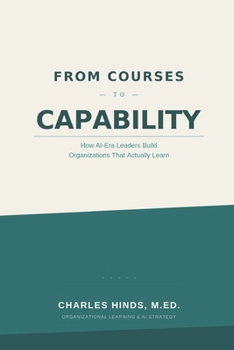
From Courses to Capability: How AI-Era Leaders Build Organizations That Actually Learn

Training ends. The real work begins.
Most organizations measure the wrong thing.
They track course completions, assessment scores, and hours of training delivered. But they rarely measure the thing that actually matters: whether people can do the job confidently when the real moment arrives.
In From Courses to Capability, Charles Hinds reveals that the most expensive gap in modern organizations is not a training gap. It is a capability gap. It shows up in slower onboarding, repeated escalations, manager overload, inconsistent decisions, rework, and delayed productivity. And in the age of AI, leaders finally have a practical way to close it.
This book introduces a new model for how organizations actually learn:
not just through formal training, but through guided practice, knowledge management, performance support, and real-time AI guidance at the moment of work. It shows leaders how to move beyond course completion metrics and build a system that helps people perform faster, with more confidence and less dependence on managers.
Inside, you will learn how to:
understand the difference between knowledge, skill, competency, and capabilitycalculate the hidden cost of the capability gap in your own organizationdesign around the moment of performance, not just the moment of traininguse AI as operational infrastructure, not just as a content toolbuild a Role Intelligence Layer that gives people trusted answers inside the flow of workturn support tickets, search data, and team questions into capability insightmake the business case for capability investment with executives and CFOslead the organizational shift from course-driven learning to capability-driven performanceWritten for CLOs, HR leaders, L&D leaders, operations executives, and transformation teams, From Courses to Capability is a practical leadership book for organizations that want to build faster, smarter, and more adaptive workforces. It is not a book about replacing people with AI. It is a book about using AI to make people more capable.
If your organization is still measuring learning by what people completed instead of what they can actually do, this book offers a better way forward.
Customer Reviews
ThriftBooks ® and the ThriftBooks ® logo are registered trademarks of Thrift Books Global, LLC
