


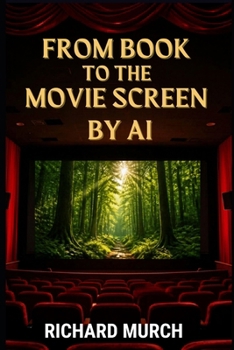
From Book to Movie Screen by AI
No Customer Reviews

There is a particular kind of frustration that every devoted reader knows. You finish a novel - perhaps one that has taken up residence inside you for days or weeks - and you close the cover with the absolute certainty that it would make a magnificent film. You can see it: the light on the protagonist's face in the opening scene, the precise angle of the camera as the climax breaks open, the music that would swell beneath the final line of dialogue.
The story is already a film inside your mind. It has always been a film inside your mind. The only problem is that nobody has made it yet. For most of the history of cinema, that gap between the imagined film and the actual film was filled by an enormous, expensive, and deeply human machine. Producers optioned rights. Screenwriters spent years distilling five hundred pages into ninety minutes of shootable drama. Directors argued about casting. Cinematographers lit and relit locations for weeks. Editors assembled and reassembled cuts until something finally cohered. The average Hollywood adaptation took between five and fifteen years from the moment a producer read the book to the moment an audience saw it on a screen. And for every book that completed that journey, thousands more never made it past the first conversation. The book you are now holding is about a technology that threatens to change all of that - not incrementally, not modestly, but in ways that are so fundamental they will require us to rethink what we mean by adaptation itself. Artificial intelligence has arrived at the doorstep of narrative cinema with a portfolio of capabilities that, taken together, suggest a near future in which the gap between written story and moving image can be closed not in years but in days. The screenwriting stage, the storyboarding stage, the visual production stage, the audio design stage - each of these, historically the province of specialized and expensive human labor, is now being approached, and in some cases already being performed, by machine intelligence. This is not a book about the death of filmmaking. It is not a polemic against artificial intelligence, nor is it an uncritical celebration of it. It is, rather, an honest and thorough investigation of a technological transition that is already underway - one whose implications for storytellers, for authors, for filmmakers, for audiences, and for the culture at large are profound enough to warrant careful, sustained attention. The chapters that follow examine the history of adaptation, the mechanics of the new AI tools, the state of current research, the leading platforms, the unresolved technical challenges, and the legal and ethical terrain that lies ahead.
The story is already a film inside your mind. It has always been a film inside your mind. The only problem is that nobody has made it yet. For most of the history of cinema, that gap between the imagined film and the actual film was filled by an enormous, expensive, and deeply human machine. Producers optioned rights. Screenwriters spent years distilling five hundred pages into ninety minutes of shootable drama. Directors argued about casting. Cinematographers lit and relit locations for weeks. Editors assembled and reassembled cuts until something finally cohered. The average Hollywood adaptation took between five and fifteen years from the moment a producer read the book to the moment an audience saw it on a screen. And for every book that completed that journey, thousands more never made it past the first conversation. The book you are now holding is about a technology that threatens to change all of that - not incrementally, not modestly, but in ways that are so fundamental they will require us to rethink what we mean by adaptation itself. Artificial intelligence has arrived at the doorstep of narrative cinema with a portfolio of capabilities that, taken together, suggest a near future in which the gap between written story and moving image can be closed not in years but in days. The screenwriting stage, the storyboarding stage, the visual production stage, the audio design stage - each of these, historically the province of specialized and expensive human labor, is now being approached, and in some cases already being performed, by machine intelligence. This is not a book about the death of filmmaking. It is not a polemic against artificial intelligence, nor is it an uncritical celebration of it. It is, rather, an honest and thorough investigation of a technological transition that is already underway - one whose implications for storytellers, for authors, for filmmakers, for audiences, and for the culture at large are profound enough to warrant careful, sustained attention. The chapters that follow examine the history of adaptation, the mechanics of the new AI tools, the state of current research, the leading platforms, the unresolved technical challenges, and the legal and ethical terrain that lies ahead.
Format:Paperback
Language:English
ISBN:B0H6XSZP17
ISBN13:9798198956575
Release Date:May 2026
Publisher:Independently Published
Length:182 Pages
Weight:0.50 lbs.
Dimensions:0.5" x 6.0" x 9.0"
Customer Reviews
0 rating
Copyright © 2026 Thriftbooks.com
Terms of Use | Privacy Policy | Do Not Sell/Share My Personal Information | Cookie Policy | Cookie Preferences | Accessibility Statement
ThriftBooks ® and the ThriftBooks ® logo are registered trademarks of Thrift Books Global, LLC
ThriftBooks ® and the ThriftBooks ® logo are registered trademarks of Thrift Books Global, LLC
