


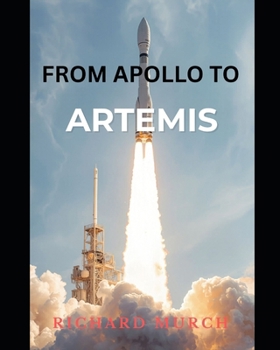
From Apollo to Artemis
No Customer Reviews

When Apollo 17 lifted off from the lunar surface in December 1972, the last humans to walk on the Moon climbed back into their ascent vehicle guided by a computer with 4 kilobytes of memory. The guidance computers of the Apollo era were extraordinary achievements for their time, capable of executing the precise calculations needed to navigate between the Earth and Moon. But they operated on fixed programs and could only do exactly what they had been told to do in advance. There was no flexibility, no learning, no adaptation. The Artemis program was not simply a restoration of what Apollo had achieved. It was the first human space exploration program designed from the outset around computational intelligence as a core engineering principle. Every phase of the mission - design, manufacturing, launch, flight, and return - was shaped by machine learning, autonomous systems, and AI-assisted decision-making in ways that would have been incomprehensible to the engineers who sent Neil Armstrong to the Sea of Tranquility.
Format:Paperback
Language:English
ISBN:B0H25NG9ZB
ISBN13:9798197356314
Release Date:May 2026
Publisher:Independently published
Length:141 Pages
Weight:0.65 lbs.
Dimensions:10.0" x 0.3" x 8.0"
Customer Reviews
0 rating
Copyright © 2026 Thriftbooks.com
Terms of Use | Privacy Policy | Do Not Sell/Share My Personal Information | Cookie Policy | Cookie Preferences | Accessibility Statement
ThriftBooks ® and the ThriftBooks ® logo are registered trademarks of Thrift Books Global, LLC
ThriftBooks ® and the ThriftBooks ® logo are registered trademarks of Thrift Books Global, LLC
