


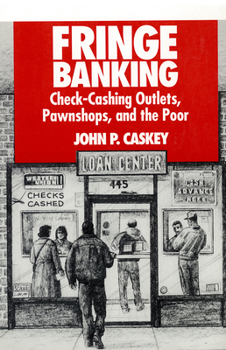
Fringe Banking: Check-Cashing Outlets, Pawnshops, and the Poor


Select Format
Select Condition 
Book Overview
Revised
Format:Paperback
Language:English
ISBN:0871541807
ISBN13:9780871541802
Release Date:March 1996
Publisher:Russell Sage Foundation
Length:179 Pages
Weight:0.60 lbs.
Dimensions:0.6" x 6.0" x 9.0"
Customer Reviews
2 ratings
Good general information on the sector
Published by Thriftbooks.com User , 16 years ago
This book offers a good analysis of the sector. My only issue with the book was that the data was a bit dated. I mistakenly thought the information was from 2006 but realized the analysis referenced facts from the mid to late 90s. But for a general reference on the space I thought it provided good background info.
Beyond the fringe
Published by Thriftbooks.com User , 17 years ago
Tens of millions of Americans -- perhaps 30 million -- do not have a bank account (including credit unions). The number has been going up, absolutely and proportionally, since the late '70s This should, in the "cashless society," be an inconvenience. It is, but less so because of pawnshops and -- to a lesser extent -- check cashing businesses. In this 1994 study for the Russell Sage Foundation, short but meaty, economist John Caskey spends a good deal of his effort in exploding myths about pawnshops. Not all their customers come in because they have no place else to turn, although for the near-destitute and desperate, pawnbrokers will provide money when no one else will. The question is, would the poor be better off if the pawnshops were more strictly regulated. After all, they charge much more, if interest is calculated as a time-value percentage, than any other kind of lender, except maybe Louie the Leg. And the related CCOs (check cashers) charge much more for cashing a check than the (usually implicit) charge by a bank. On the whole, Caskey concludes, no. More regulations would drive pawnshops out of business, and since no one else would step in to provide lending accommodations for the unbanked, these people would have to turn to Louie. In many other countries there are low- or no-profit municipal pawnshops -- the Dorotheum in Vienna is over three centuries old -- but Caskey does not believe Americans would go for that. What they had gone for, and very obviously when he did his research in the early '90s, was pawnshops allowed to charge high interest rates. Surprisingly, the states that raised their limits were concentrated in the South and Mountain states, where there are now thousands of pawnshops. New York State had, in 1993, only a few dozen, about the same number as Hawaii with a population about 35 times smaller. But there are thousands in Texas. Although Caskey does not say so explicitly, he cites statistics in such as way as to leave the impression -- entirely correct -- that the explosion in the number of unbanked is correlated with the Reagan-Bush policies of destroying ordinary jobs and transferring wealth from the poor (who have little individually but substantial amounts in aggregate) to the rich. But he has to walk a fine line, because suggesting that some poor are that way because they are improvident would bring down the wrath of the do-gooding left. "I tread carefully in making these points," Caskey writes, "because they are sensitive." He concludes, however, that it is not poverty as such that keeps people (not all very poor) unbanked. Rather it is in large measure a tumultous income history. Periods of illness, joblessness or rootlessness cause payments to be missed, making people ineligible for cheaper (by the transaction) bank services -- whether cashing a paycheck or Social Security check or obtaining a small loan. He observes that of the aspiring poor (including many new immigrants), "the first financial a
Copyright © 2026 Thriftbooks.com
Terms of Use | Privacy Policy | Do Not Sell/Share My Personal Information | Cookie Policy | Cookie Preferences | Accessibility Statement
ThriftBooks ® and the ThriftBooks ® logo are registered trademarks of Thrift Books Global, LLC
ThriftBooks ® and the ThriftBooks ® logo are registered trademarks of Thrift Books Global, LLC
