


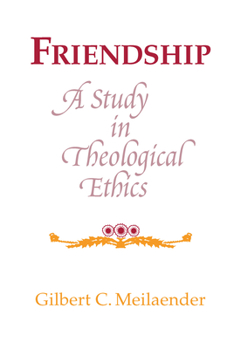
Friendship: A Study in Theological Ethics


Select Format
Select Condition 
Book Overview
Certain relationships are of profound importance for the moral life. Gilbert C. Meilaender explores some of the tensions which Christian experience discovers in one such relationship, the bond of friendship. These tensions help to explain why friendship was a more important topic in the life and thought of the classical civilizations of Greece and Rome than it has unusually been within Christendom. The bond of friendship (philia) involves special preference; Christian love (agape) is thought to be like the love of the heavenly Father who makes his sun rise on the evil and the good and sends rain on the just and the unjust. Philia requires that love be returned; agape is to be shown even the enemy, who does not love in return. Friendships sometimes fade away; Christians are enjoined to be faithful in love. These tensions have permeated our lives and helped to shape our world. We think politics a more important sphere than the private friendship bond. We seek fulfillment in and identify ourselves with our vocations -- by which we now mean, work for pay -- not our friendships. And in a world where politics and vocation are all-important, lasting friendships become more difficult to sustain. Friendship examines the tension between philia and agape and probes its significance for Christian thought and experience.
Format:Paperback
Language:English
ISBN:0268009694
ISBN13:9780268009694
Release Date:November 1981
Publisher:University of Notre Dame Press
Length:128 Pages
Weight:0.41 lbs.
Dimensions:0.3" x 5.0" x 8.0"
Customer Reviews
1 rating
Friendship Love Matters
Published by Thriftbooks.com User , 23 years ago
This classic study in theological ethics is written to argue that philia deserves an honored place within Christian ethics. Meilaender notes that at one time philia, rather than agape or charity, was the common way to understand love. However, agape displaced philia in Christian thought, and the author attempts to think theologically about this displacement in this book. Friendship examines the tension between philia and agape and probes the significance of this tension for Christian thought experience.Each chapter explores a way in which philia, as a preferential bond, is important for understanding theological ethics. While agape is to be shown even to the enemy, philia is a mutual bond marked by inner reciprocities. While agape is said to be characterized by the fidelity and changelessness of God in covenant, philia is recognized to be the subject of change. While agape has been used to designate the search for a suprahistorical resting place in God, philia is the noblest thing aspired to in civics. While agape understands one's vocation as the supremely important form of service to neighbor, philia emphasizes the bond of relationship toward those with personal significance. In all of these contrasts, the author notes that the central element in their tension is the preferential character of friendship. "Whatever its dangers, friendship is surely a bond of great significance for human life. No adequate theological ethic can fail to make place for it. When Christ came into this world, he came to his own, John's Gospel tells us. And the divine love which Christ displays -- God' agape -- cannot therefore be entirely alien to the needs and possibilities of our human nature" (105).
Copyright © 2026 Thriftbooks.com
Terms of Use | Privacy Policy | Do Not Sell/Share My Personal Information | Cookie Notice | Cookie Preferences | Accessibility Statement
ThriftBooks ® and the ThriftBooks ® logo are registered trademarks of Thrift Books Global, LLC
ThriftBooks ® and the ThriftBooks ® logo are registered trademarks of Thrift Books Global, LLC
