


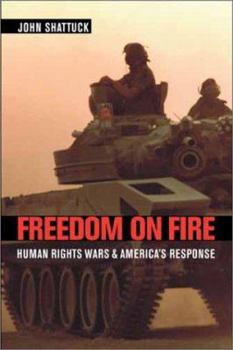
Freedom on Fire: Human Rights Wars and America’s Response

As the chief human rights official of the Clinton Administration, John Shattuck faced far-flung challenges. Disasters were exploding simultaneously - genocide in Rwanda and Bosnia, murder and atrocities in Haiti, repression in China, brutal ethnic wars, and failed states in other parts of the world. But America was mired in conflicting priorities and was reluctant to act. What were Shattuck and his allies to do? This is the story of their struggle inside the US government over how to respond. Shattuck tells what was tried and what was learned as he and other human rights hawks worked to change the Clinton Administration's human rights policy from disengagement to saving lives and bringing war criminals to justice. He records his frustrations and disappointments, as well as the successes achieved in moving human rights to the centre of US foreign policy. interview the survivors of Srebrenica. He confronted Milosevic in Belgrade. He was a key player in bringing the leaders of genocide in Bosnia and Rwanda to justice. He pushed from the inside for an American response to the crisis of the Haitian boat people. He pressed for the release of political prisoners in China. His book is both an insider's account and a detailed prescription for preventing such wars in the future. undermines human rights at home and around the world. He argues that human rights wars are breeding grounds for terrorism. Freedom on Fire describes the shifting challenges of global leadership in a world of explosive hatreds and deepening inequalities.
Format:Hardcover
Language:English
ISBN:0674011627
ISBN13:9780674011625
Release Date:November 2003
Publisher:Harvard University Press
Length:400 Pages
Weight:0.10 lbs.
Dimensions:6.0" x 1.3" x 8.5"
Customer Reviews
2 ratings
When to intervene
Published by Thriftbooks.com User , 21 years ago
This book makes a significant contribution in offering real criteria for U.S. intervention on behalf of innocent victims in an ongoing human rights crisis. It shows many tools that can be used short of a military invasion, and sets forth rational arguments for when a military invasion is the appropriate response. It is unusual in that it is not a biased ideological (liberal or conservative, Democrat or Republican) book, but rather a dispassionate study based on real experience in the government. A must-read for anyone interested in effective promotion of human rights.
Losing the Good Fight
Published by Thriftbooks.com User , 22 years ago
John Shattuck was the top human rights official at the State Department in the 1990s when genocides occurred in Rwanda and Bosnia and the U.S. did nothing to stop them. This fascinating book explains how that happened. It discusses four human rights crises that occurred on Shattuck's watch in Rwanda, Bosnia, Haiti, and China. In each case, a robust U.S. response was blocked or watered down by weak White House leadership, partisan sniping from Republicans, opposition from the business community, or the military's aversion to getting sucked into "another Somalia." Shattuck doesn't engage in petty recriminations and admits that he was sometimes overwhelmed and ineffective. His book is thoughtful, well-written, and depressing. (I'm a foreign service officer who served under Shattuck in the mid-1990s. Although Shattuck was marginalized by the State Department's bureaucracy, he was regarded as an honorable and honest official. There's no reason to disbelieve anything he reports in this book.)
Copyright © 2026 Thriftbooks.com Terms of Use
| Privacy Policy | Do Not
Sell/Share My Personal Information | Cookie Policy | Cookie Preferences | Accessibility Statement
ThriftBooks® and the ThriftBooks® logo are registered trademarks of Thrift Books Global, LLC
ThriftBooks® and the ThriftBooks® logo are registered trademarks of Thrift Books Global, LLC
