


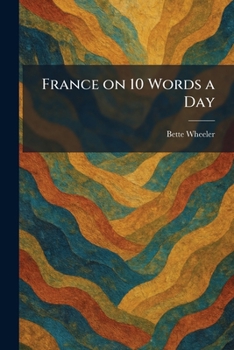
France on 10 Words a Day

Select Format
Select Condition 
Book Overview
"France on 10 Words a Day." is an accessible and practical guide designed for the English-speaking traveler navigating the cultural and linguistic landscape of France during the late 1920s. Recognizing that many visitors feel overwhelmed by the complexities of a foreign tongue, Bette Wheeler presents a streamlined approach to communication that focuses on essential vocabulary and daily interactions.
This work serves as both a functional phrasebook and a cultural primer, offering readers the linguistic tools necessary to handle common travel scenarios-from ordering meals and securing lodging to asking for directions and shopping in local markets. By breaking down the language into manageable segments, the book empowers travelers to engage more deeply with their surroundings without the need for extensive formal study. The text reflects the specific charm and social etiquette of the interwar period, providing a unique window into the historical relationship between international tourists and their French hosts.
Whether viewed as a nostalgic look at the Golden Age of European travel or as a study in simplified language instruction, "France on 10 Words a Day." remains a testament to the enduring desire for cross-cultural connection. It is an ideal resource for those interested in the history of tourism, the evolution of language education, and the timeless allure of the French experience.
This work has been selected by scholars as being culturally important, and is part of the knowledge base of civilization as we know it. This work was reproduced from the original artifact, and remains as true to the original work as possible. Therefore, you may see the original copyright references, library stamps (as most of these works have been housed in our most important libraries around the world), and other notations in the work.
This work is in the public domain in the United States of America, and possibly other nations. Within the United States, you may freely copy and distribute this work, as no entity (individual or corporate) has a copyright on the body of the work.
As a reproduction of a historical artifact, this work may contain missing or blurred pages, poor pictures, errant marks, etc. Scholars believe, and we concur, that this work is important enough to be preserved, reproduced, and made generally available to the public. We appreciate your support of the preservation process, and thank you for being an important part of keeping this knowledge alive and relevant.
Customer Reviews
ThriftBooks ® and the ThriftBooks ® logo are registered trademarks of Thrift Books Global, LLC
