


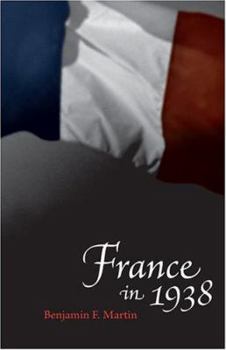
France In 1938


Select Format
Select Condition 
Book Overview
At the beginning of 1938, containment of Nazi Germany by a coalition of eastern and western democracies without resorting to war was still a distinct possibility. By the end of 1938, however, Germany was much stronger, the western democracies stood alone, and war was all but certain. The primary cause for these developments, argues Benjamin F. Martin, was the foreign and domestic policies adopted by the French government and embraced by the French people. In a riveting account of the dark days leading up to France's defeat and occupation, Martin reveals a great and civilized nation committing a kind of suicide in 1938. Using movies, novels, newspapers, and sensational court cases, Martin weaves an absorbing tale of France's collective fear and melancholy during this troubled prewar period. He masterfully counts the small change of history - those seemingly unimportant incidents that together compose daily life - by chronicling the four seasons of 1938. From the upset of relative calm in the first quarter with Germany's invasion of Austria to the sense of doom reflected in the year's films noir, Martin addresses both the day-to-day events and the major topics of the time. perspective of 1940. Exhibiting his trademark compelling narrative style, sense for unusual and telling detail, and vivid portraits of individual men and women, Martin brings remarkable texture to this depiction of a society and period. He recreates life in France during the year when terrors to come could already be imagined only too well.
Format:Hardcover
Language:English
ISBN:0807130508
ISBN13:9780807130506
Release Date:January 2005
Publisher:Louisiana State Univ Pr
Length:252 Pages
Weight:1.10 lbs.
Dimensions:8.5" x 1.0" x 5.8"
Customer Reviews
2 ratings
France before the war.
Published by Thriftbooks.com User , 18 years ago
This is a nice read for those interested in World War Two. Why didn't the Western allies do more in stopping the Germans from their aggression against Austria and Czechoslovakia. This book gives the answer. The author details how the society functioned in the critical year of 1938. The country had a coalition government under the broad umbrella of the Popular Front. However, the coalition could not come to an agreement who posed the greatest risk--the Soviet Union, Nazi Germany, or Fascist Italy. The looming threat of an aggressive Germany was disregarded by many elements of society. Most did not want to increase the work week from 40 hours to 48 hours to rearm the country. Internal divisions and elements weakened the country to the point where France let Germany have Austria and Czechoslovakia. The British also did not have much spine. This is a unique book. Why World War II happened is because of the lack of resolve from Great Britain and France. This book shows the reasons France lacked that resolve.
Appeasing the Devil
Published by Thriftbooks.com User , 20 years ago
This fascinating book will take you back into time. This is especially so if you believe, as I do, that many lessons for our contemporary time can be gleaned from the experience of those who came before us. Benjamin F. Martin has done a great service in helping us to feel the pulse of the French nation just prior to the outbreak of World War II. He traces its inner conflicts and political maneuvers and gives us a look inside the French psyche in the two years running up to the start of war. Desperate to avoid war, the French made the mistake of bargaining with the devil. Kneeling before Hitler, they vainly and dangerously believed that the pacts he brokered had meaning for a world desiring peace. But those pacts--and the time spent preparing them--were nothing more than opportunities for Hitler to strengthen his own hand. Martin quotes Winston Churchill's evaluation of the Munich Pact, and it is appropriately directed not only to the British Prime Minister of the time (Neville Chamberlain), but to the French: "You were given the choice between war and dishonor. You chose dishonor and you will have war." Beyond my fascination with history, I am grateful for this book for another reason. I wonder if it is not an important reminder that we need again today. Are there parallels to be made between Europe in the late 1930s and the world as we know it now, faced with the unending violence perpetrated by terrorist extremists? Perhaps. Perhaps not. Read this book and draw your own conclusions. Are we who forget history not doomed to repeat it?
Copyright © 2026 Thriftbooks.com Terms of Use
| Privacy Policy | Do Not
Sell/Share My Personal Information | Cookie Policy | Cookie Preferences | Accessibility Statement
ThriftBooks® and the ThriftBooks® logo are registered trademarks of Thrift Books Global, LLC
ThriftBooks® and the ThriftBooks® logo are registered trademarks of Thrift Books Global, LLC
