


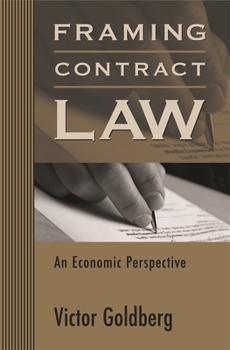
Framing Contract Law: An Economic Perspective
No Customer Reviews

Select Format
Select Condition 
Book Overview
The central theme of this book is that an economic framework--incorporating such concepts as information asymmetry, moral hazard, and adaptation to changed circumstances--is appropriate for contract interpretation, analyzing contract disputes, and developing contract doctrine. The value of the approach is demonstrated through the close analysis of major contract cases. In many of the cases, had the court (and the litigators) understood the economic context, the analysis and results would have been very different. Topics and some representative cases include consideration (Wood v. Lucy, Lady Duff Gordon), interpretation (Bloor v. Falstaff and Columbia Nitrogen v. Royster), remedies (Campbell v. Wentz, Tongish v. Thomas, and Parker v. Twentieth Century Fox), and excuse (Alcoa v. Essex).
Format:Paperback
Language:English
ISBN:0674063929
ISBN13:9780674063921
Release Date:March 2012
Publisher:Harvard University Press
Length:424 Pages
Weight:1.10 lbs.
Dimensions:1.1" x 6.1" x 9.1"
Customer Reviews
0 rating
Copyright © 2026 Thriftbooks.com Terms of Use
| Privacy Policy | Do Not
Sell/Share My Personal Information | Cookie Policy | Cookie Preferences | Accessibility Statement
ThriftBooks® and the ThriftBooks® logo are registered trademarks of Thrift Books Global, LLC
ThriftBooks® and the ThriftBooks® logo are registered trademarks of Thrift Books Global, LLC
