


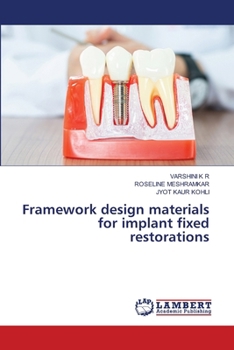
Framework design materials for implant fixed restorations
No Customer Reviews

Frameworks must be fabricated from materials and protocols that allow passive and accurate fit between frameworks and implants and/or abutments. CAD/CAM fabricated frameworks generally provide better, more accurate fit than do cast frameworks.Framework design has evolved into a series of clinical and laboratory procedures that incorporate principles of fixed and removable prosthodontics; prostheses are more successful if frameworks are designed consistent with predetermined tooth positions.Frameworks must be designed with adequate space (1.5 to 2 mm) for prosthetic materials: acrylic resin/composite resin/reinforced polymeric materials. Retentive elements for denture base materials should be designed as integral parts of implant frameworks. Adequate thickness is necessary to minimize the potential for denture base fracture. Acrylic resin retention may be accomplished with nail head retentive elements, retentive loops, or undercut areas randomly placed throughout frameworks. Retentive elements should be placed such that they will not interfere with tooth placement.
Format:Paperback
Language:English
ISBN:6208445981
ISBN13:9786208445980
Release Date:May 2025
Publisher:LAP Lambert Academic Publishing
Length:164 Pages
Weight:0.50 lbs.
Dimensions:0.4" x 6.0" x 9.0"
Customer Reviews
0 rating
Copyright © 2026 Thriftbooks.com
Terms of Use | Privacy Policy | Do Not Sell/Share My Personal Information | Cookie Notice | Cookie Preferences | Accessibility Statement
ThriftBooks ® and the ThriftBooks ® logo are registered trademarks of Thrift Books Global, LLC
ThriftBooks ® and the ThriftBooks ® logo are registered trademarks of Thrift Books Global, LLC
