


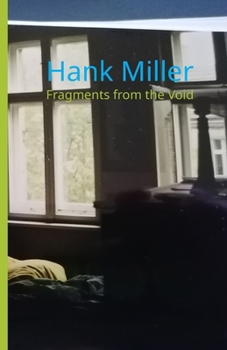
Fragments from the Void

"Present as Ruin" by Rosine Berlin
It feels almost as though Hank Miller, even in his third volume, is not writing but rather documenting. There is no classical storytelling, no poem that concludes, no short story aiming for a punchline. Fragments from the Void is a book that refuses to become whole. And in this refusal lies its consistency.
Even the two predecessors - Timeless Spaces and I Lean on the Emptiness - were hailed as classics of writing beyond the literary world: texts without ambitions for literary careers, but with existential urgency. And now, the third volume. No conclusion, rather another break.
What immediately strikes the reader is that time here is not a flow, but a stutter. "10 hours. Good morning. 12 o'clock. Food. 4 hours time." These repetitions are not mere formal games. They recall shift schedules, clinic rhythms, addiction days, prison terms - lives that no longer move forward but turn in circles. Miller does not write time as a continuum, but as the decay of the present.
Death is not awaited; it has already moved in: "Good morning, death." The "I" speaking here is not a sovereign lyrical subject. It is fragmented, mirrored, permeable. Again and again, the doppelg nger appears, the face behind the eyes, the foreign self in the own body. Life and death are not opposites; they overlap. Birth is not a beginning but a continuation of the end. "No death, but life ends with every birth."
Formally, the book is radically inconsistent. Poems break off into prose, diary entries tip into nightmare sequences, fragments of dialogue stand next to visionary images. English and German interpenetrate, not out of coolness, but out of inner tornness. The language shifts where German is no longer enough - or where English too fails: "I can't see the light."
Striking are the texts where the personal intertwines with the global. The Green Planet Bleeds is not an ecological poem in an activist sense. It is a lament without hope for salvation. The planet does not die spectacularly, but exhaustively. Its death is - frighteningly enough - a release. This perspective is uncomfortable but consistent: anyone who writes about dying for so long cannot moralize death.
Places keep reappearing: Berlin, Melbourne, Rockhampton, anonymous rooms, pubs, hostels, train stations. These are passage spaces, non-places. No one arrives, no one stays. The people in these texts live "dead for years" and still try to live their lives. Alcohol, drugs, music, fleeting encounters - they are not acts of rebellion, but delays.
Miller's closeness to spoken language is notable. Entire passages read like tape recordings from pubs, like memories that do not dare to express themselves. The famous "realistic" sound of the 90s is not nostalgic here, but hollowed out. What remains is fatigue. And sometimes, rarely, tenderness. Like in the love text to the woman, which tells of missed moments - of not saying, of not acting. No grand gestures, just the quiet knock on the door.
The war sequence at the end is not a dystopian draft, but a report on the state of things. The war is here, without explanation, without ideology. It begins with a kiss and ends in beer cellars and polluted water. Communication breaks down, carrier pigeons replace the media. The great catastrophe appears casually - like everything in this book.
Perhaps Fragments from the Void is not a book for readers seeking comfort. But it is a book for those who know that literature does not have to heal. That sometimes it can only witness. Be still. Endure.
In the end, there is no "Amen." No "Our Father." No conclusion. Only silence. And in this volume, that silence is not a void - but a form of truth.
Fragments from the Void is uncomfortable, radical, necessary. Anyone seeking answers will be disappointed.
Customer Reviews
ThriftBooks® and the ThriftBooks® logo are registered trademarks of Thrift Books Global, LLC
