


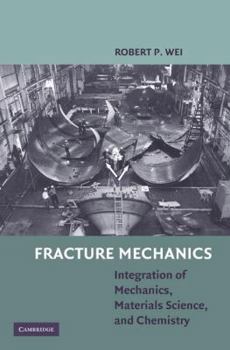
Fracture Mechanics: Integration of Mechanics, Materials Science and Chemistry
No Customer Reviews

Fracture and "slow" crack growth reflect the response of a material (i.e., its microstructure) to the conjoint actions of mechanical and chemical driving forces and are affected by temperature. There is therefore a need for quantitative understanding and modeling of the influences of chemical and thermal environments and of microstructure, in terms of the key internal and external variables, and for their incorporation into design and probabilistic implications. This text, which the author has used in a fracture mechanics course for advanced undergraduate and graduate students, is based on the work of the author's Lehigh University team whose integrative research combined fracture mechanics, surface and electrochemistry, materials science, and probability and statistics to address a range of fracture safety and durability issues on aluminum, ferrous, nickel, and titanium alloys and ceramics. Examples from this research are included to highlight the approach and applicability of the findings in practical durability and reliability problems.
Format:Hardcover
Language:English
ISBN:052119489X
ISBN13:9780521194891
Release Date:February 2010
Publisher:Cambridge University Press
Length:230 Pages
Weight:1.40 lbs.
Dimensions:0.8" x 7.0" x 10.0"
Related Subjects
Engineering Science Science & Math Science & Scientists Science & Technology TechnologyCustomer Reviews
0 rating
Copyright © 2026 Thriftbooks.com Terms of Use
| Privacy Policy | Do Not
Sell/Share My Personal Information | Cookie Policy | Cookie Preferences | Accessibility Statement
ThriftBooks® and the ThriftBooks® logo are registered trademarks of Thrift Books Global, LLC
ThriftBooks® and the ThriftBooks® logo are registered trademarks of Thrift Books Global, LLC
