


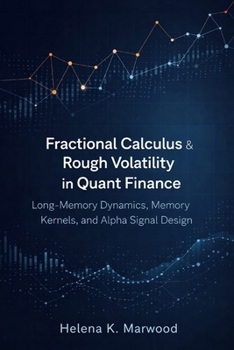
Fractional Calculus & Rough Volatility in Quant Finance: Long-Memory Dynamics, Memory Kernels, and Alpha Signal Design

Markets exhibit persistence. Volatility clusters. Order flow remembers. Classical stochastic models often assume away these structural memory effects. This book confronts that assumption directly.
Fractional Calculus & Rough Volatility in Quant Finance presents a rigorous yet applied framework for modeling long-memory dynamics in financial time series. It bridges fractional calculus, memory kernels, rough path theory, and modern alpha construction into a unified quantitative architecture.
You will learn how to:
Model persistent volatility using fractional Brownian motion and rough volatility frameworks
Implement fractional differentiation and memory kernels in Python
Detect long-memory structure using Hurst exponent estimation techniques
Translate memory dynamics into systematic trading signals
Integrate rough paths into volatility forecasting and signal filtering
Design alpha factors grounded in structural persistence rather than short-term noise
The text moves from theory to implementation with step-by-step mathematical exposition and production-ready code examples. It emphasizes statistical validation, signal robustness, and regime sensitivity.
This is not a surface-level overview. It is written for quantitative researchers, advanced traders, financial engineers, and graduate-level students who want to move beyond Markovian assumptions and build models that reflect how markets actually behave.
If you are building systematic strategies, volatility models, or research pipelines, this book provides the mathematical tools and implementation framework to incorporate memory directly into your alpha architecture.
Customer Reviews
ThriftBooks ® and the ThriftBooks ® logo are registered trademarks of Thrift Books Global, LLC
