


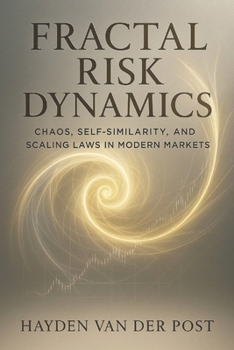
Fractal Risk Dynamics: Chaos, Self-Similarity, and Scaling Laws in Modern Markets: A Quantitative Exploration of Nonlinear Risk, Fractal Volatility, a

Fractal Risk Dynamics: Chaos, Self-Similarity, and Scaling Laws in Modern Markets unveils the hidden geometry that underpins financial volatility. Where traditional models assume order and equilibrium, real markets reveal fractal complexity-structures that repeat, scale, and evolve across every time horizon.
In this groundbreaking guide, Hayden Van Der Post bridges mathematics, physics, and finance to expose the nonlinear foundations of modern risk. You'll explore how fractal volatility emerges from self-organized market behavior, why scaling laws reveal universal constants across asset classes, and how chaos theory redefines the limits of prediction.
Through advanced yet accessible explanations, this book teaches you how to quantify uncertainty using multifractal analysis, design volatility surfaces informed by scaling exponents, and apply complexity modeling to portfolio optimization and risk forecasting.
Whether you're a quantitative analyst, trader, or researcher, Fractal Risk Dynamics will transform the way you perceive financial systems-from random noise to living, self-similar organisms driven by feedback, memory, and evolution.
Key Topics Include:
Fractal and multifractal modeling of volatility and price movements
Scaling laws, power distributions, and turbulence analogies in finance
Chaos, attractors, and sensitivity in market systems
Nonlinear feedback loops and emergent risk patterns
Practical Python implementations for fractal risk metrics and simulations
Step beyond conventional risk models and discover the fractal architecture of modern finance.
Customer Reviews
ThriftBooks ® and the ThriftBooks ® logo are registered trademarks of Thrift Books Global, LLC
