


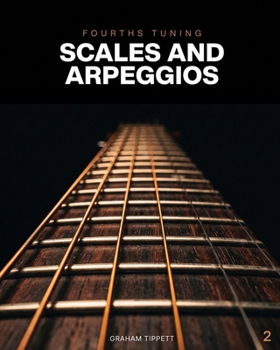
Fourths Tuning: Scales and Arpeggios

Everything you can play stops working. Your scale patterns, your arpeggio shapes, twenty years of muscle memory -- all of it was built around a major third between the G and B strings that no longer exists. Most players who try fourths tuning give up here, not because the tuning is hard but because going back to being a beginner is intolerable.
You don't have to. This book gets you back to fluency in three stages.
First, transfer what you already knowThe patterns change; the theory behind them doesn't. The book opens by mapping your existing standard-tuning knowledge straight onto the new fretboard, so you're improvising in the first week rather than waiting out six months of memorising shapes.
Then, learn a system built for this tuningStandard tuning scale systems are workarounds. Every one of them exists to accommodate the B string anomaly. The second section replaces them with a system designed around the symmetry fourths tuning actually gives you -- full coverage of the neck in any key, with considerably less to memorise.
Then stop using shapesThe last section is the reason to be in this tuning at all. With the same interval between every pair of strings, the neck becomes navigable by interval rather than by shape: you build scales, arpeggios and chords on the spot from formulas instead of recalling stored patterns. This is difficult in standard tuning and unreasonably easy here.
Who it's forGuitarists moving from standard to fourths who want the fastest structured route back to playing. Also for anyone already in fourths who has been getting by on transferred standard-tuning shapes and can tell they're leaving something on the table.
The companion volume Fourths Tuning -- Chords and Inversions covers the harmonic side. You don't need it to use this one.
Customer Reviews
ThriftBooks ® and the ThriftBooks ® logo are registered trademarks of Thrift Books Global, LLC
