


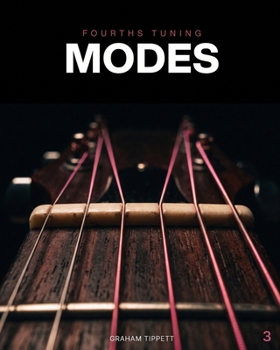
Fourths Tuning: Modes

Most guitarists who give up on modes assume they've hit a theory wall. Usually they've hit a tuning problem. Every modal pattern in standard tuning has to be adjusted as it crosses the G and B strings, so nothing ever feels consistent, and the inconsistency gets mistaken for the concept being difficult.
Take the major third out and it stops. A modal pattern learned in one position transfers identically to every other position, in every key, with nothing to adjust. The theory that felt abstract turns out to have been fine all along.
Modes both ways roundThe confusion that never gets resolved is whether a mode is a scale or a way of looking at a key. It's both, and which one you need depends on what you're playing over. This book covers each properly: modes as parent scales for diatonic progressions, and modes as scales in their own right for improvising over isolated chords and the non-diatonic writing common in fusion.
Major scale modes and melodic minor modes, with the theory kept short - enough to know what you're doing, no further.
Also coveredFinding the parent scale of any mode instantly. Building modal chord progressions that actually sound modal. Using backing tracks in a way that develops your ear rather than just filling silence. And a way of organising the whole thing on the fourths fretboard that needs no pattern drilling.
Who it's forPlayers in fourths tuning who want a complete modal system for the neck they're actually on. Also for anyone moving over from standard, where working through modes in fourths tends to clear up confusion that standard tuning caused in the first place.
Book three of the Fourths Tuning series, and the one that repays the switch most obviously. It reads on its own.
Customer Reviews
ThriftBooks ® and the ThriftBooks ® logo are registered trademarks of Thrift Books Global, LLC
