


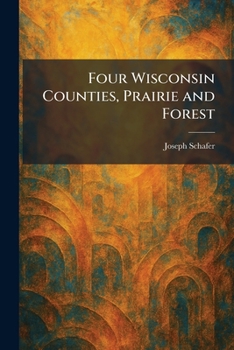
Four Wisconsin Counties, Prairie and Forest

Select Format
Select Condition 
Book Overview
"Four Wisconsin Counties, Prairie and Forest" is a comprehensive historical and geographical exploration of the settlement and development of southeastern Wisconsin. Written by Joseph Schafer, a distinguished historian and superintendent of the State Historical Society of Wisconsin, this work meticulously examines the evolution of the landscape from its natural prairie and forest states into thriving agricultural and industrial communities.
The study focuses on the intricate relationships between the physical environment and the social, political, and economic lives of early pioneers. Through detailed analysis, Schafer captures the patterns of land ownership, the cultural origins of diverse immigrant groups, and the growth of vital local institutions. This volume serves as a critical resource for understanding the pioneering spirit of the Midwest and the foundational history of the state of Wisconsin. By documenting the transition from wilderness to structured civilization, the work offers invaluable insights into the regional heritage of the Great Lakes area, making it an essential text for historians, genealogists, and anyone interested in the social development of the American frontier.
This work has been selected by scholars as being culturally important, and is part of the knowledge base of civilization as we know it. This work was reproduced from the original artifact, and remains as true to the original work as possible. Therefore, you may see the original copyright references, library stamps (as most of these works have been housed in our most important libraries around the world), and other notations in the work.
This work is in the public domain in the United States of America, and possibly other nations. Within the United States, you may freely copy and distribute this work, as no entity (individual or corporate) has a copyright on the body of the work.
As a reproduction of a historical artifact, this work may contain missing or blurred pages, poor pictures, errant marks, etc. Scholars believe, and we concur, that this work is important enough to be preserved, reproduced, and made generally available to the public. We appreciate your support of the preservation process, and thank you for being an important part of keeping this knowledge alive and relevant.
Customer Reviews
ThriftBooks ® and the ThriftBooks ® logo are registered trademarks of Thrift Books Global, LLC
