


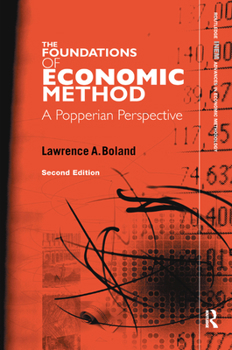
Foundations of Economic Method: A Popperian Perspective, 2nd Edition


Select Format
Select Condition 
Book Overview
This updated edition is radically changed from the original and will be much appreciated by thinkers within economics. Boland is back.
Format:Hardcover
Language:English
ISBN:1138160474
ISBN13:9781138160477
Release Date:February 2017
Publisher:Routledge
Length:364 Pages
Weight:1.48 lbs.
Dimensions:0.8" x 6.1" x 9.2"
Customer Reviews
2 ratings
Application of "Socratic" Popperianism
Published by Thriftbooks.com User , 16 years ago
Rafe Champion's review is accurate. Boland is a 'critical rationalist' - that is, he's a follower of Karl Popper (but not as a naive falsificationist). For him, critical rationalism is a Socratic attitude and approach - one looks for ways of critically interrogating beliefs and propositions in the hope of showing up flaws and thus avoiding mistakes in the future. He applies this attitude to neoclassical theory and seeks to figure out what its underlying 'agenda' is, and how it might be reformed to the advantage of economists' practices. The book is packed with dense arguments, perhaps too much so. It is also idiocyncratic in the extreme, reflecting Boland's unique 'take' on neoclassical economics and his own interpretation of what is involved in practising economic methodology (to say nothing of the 'Socratic' interpretation of Popper - accurate though it may be). As such, this is not a good 'textbook' on economic methodology for the novice or an economist unschooled in methodology. It is really a book for those familar with the field of economic methodology and the philosophy of science.
Getting at the core of neoclassical economic theory
Published by Thriftbooks.com User , 23 years ago
In this book Lawrence Boland critically explores the agenda of the neoclassical research program, especially some of the unstated assumptions of the "hidden agenda" which are seldom subjected to scrutiny. This approach is "imminent criticism", working within the assumptions of the system to explore their consistency and the capacity of the system to succeed on its own terms. "External" or "transcendent" criticism takes issue with the assumptions, working outside the system. These could be respectively called the "worm" and "sparrow" approach. This is written without prejudice against worms for which, like Charles Darwin, I have a high regard. There is so little discussion of methodology among economists that some detective work is required to locate the methodological ideas that are at work. Boland was determined to identify the actual practice in the profession, as distinct from the incantations that are offered in the early part of textbooks.He suggests that the hidden agenda of the field consists of two related but autonomous problems; first, the Problem of Induction; second, the Explanatory Problem of Individualism. These are explored in chapters 1 and 2. Their influence on research programs in neoclassical economics is pursued in chapters 3 to 6. Their influence on the practice of methodology in the field is presented in chapters 7 to 9. Alternative approaches are examined in chapters 10 to 12.As to the Problem of Induction, this has mostly been shifted to the Problem of Conventionalism: "the problem of finding generally accepted criteria upon which to base any contingent, deductive proof of any claim to empirical 'knowledge'". In practice, the generally accepted criteria have produced a form of normal science where the puzzles are concerned either with econometric models or mathematical models. In the first instance, the requirements of science are met by using data, with some talk about falsification, confirmation and the like. In the second instance the criteria run along the lines of simplicity, economy, elegance and other considerations of mathematics.Moving on to the other leg of the agenda, the Explanatory Problem of Individualism, otherwise known as Methodological Individualism (MI), this is the view that only individuals can be the decision-makers in any explanation of social events. Boland explains that the usual form that MI takes in the neoclassical research program is psychologism, "the prescription that psychological states are the only exogenous [unexplained] variables permitted beyond natural givens (weather, contents of the universe, etc)". The bottom line of the argument here is that psychologism is retained because it is a part of the Conventionalist program to deal with the problem of induction. Boland turns to Popper as a corrective to inductivism. His views came to economists in the unhelpful form of "falsificationism" and various forms of his ideas are attributed to both Friedman and Samuelson, who are probably the mos
Copyright © 2026 Thriftbooks.com Terms of Use
| Privacy Policy | Do Not
Sell/Share My Personal Information | Cookie Policy | Cookie Preferences | Accessibility Statement
ThriftBooks® and the ThriftBooks® logo are registered trademarks of Thrift Books Global, LLC
ThriftBooks® and the ThriftBooks® logo are registered trademarks of Thrift Books Global, LLC
