


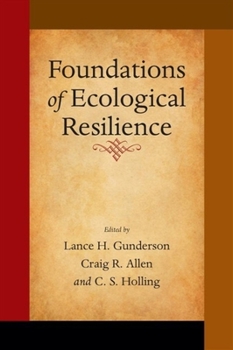
Foundations of Ecological Resilience

Select Format
Select Condition 
Book Overview
Ecological resilience provides a theoretical foundation for understanding how complex systems adapt to and recover from localized disturbances like hurricanes, fires, pest outbreaks, and floods, as well as large-scale perturbations such as climate change. Ecologists have developed resilience theory over the past three decades in an effort to explain surprising and nonlinear dynamics of complex adaptive systems. Resilience theory is especially important to environmental scientists for its role in underpinning
adaptive management approaches to ecosystem and resource management.
Foundations of Ecological Resilience is a collection of the most important articles on the subject of ecological resilience--those writings that have defined and developed basic concepts in the field and help explain its importance and meaning for scientists and researchers.
Foundations of Ecological Resilience is an important contribution to our collective understanding of resilience and an invaluable resource for students and scholars in ecology, wildlife ecology, conservation biology, sustainability, environmental science, public policy, and related fields.
Customer Reviews
ThriftBooks ® and the ThriftBooks ® logo are registered trademarks of Thrift Books Global, LLC
